
The Certificate of Accuracy: What Attorneys Should Check Before a Translated Document Reaches Discovery
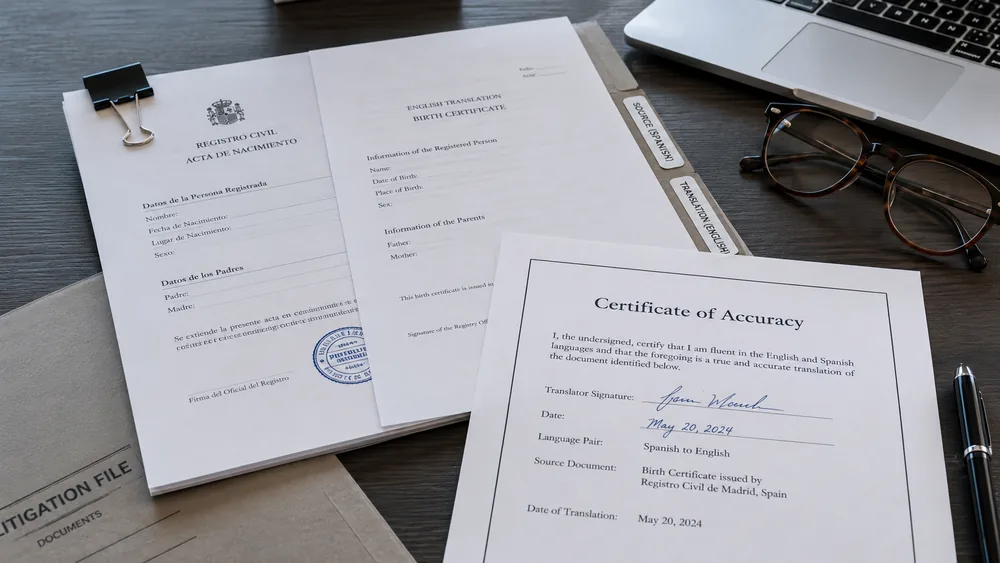
A certificate of accuracy is a signed statement the translator will defend under oath. It is not a stamp. If it is missing, generic, or signed by someone whose credential the record cannot support, the translation is one motion away from being pulled out of evidence. Here is what should be on it, in Q&A form, before the packet ships.
What is a certificate of accuracy?
It is a signed statement, typically on the translation itself or attached as a single page, in which the translator attests that the translation is a true and complete rendering of the source document, and that the translator is competent to translate between the two languages.
Under USCIS document translation requirements at 8 CFR 103.2(b)(3), any foreign-language document submitted with an application must include an English translation the translator has certified as complete and accurate, along with the translator’s certification of competency. Federal courts, state courts, and administrative agencies apply similar attestation standards to translated exhibits. The American Translators Association publishes a widely used certification format and maintains the certification exam that many legal translators reference to establish competency. Most reputable certified document translation services follow either the ATA format or an equivalent that covers the same core elements.
“Certified” is not a checkbox. It is a working legal instrument that has to hold up when someone reads it against the original and asks who translated it, what their credential is, and whether they will sign a declaration to that effect. That standard applies whether the packet is a certified legal translation for a contract dispute, a certified medical translation for a personal-injury case, or a certified document translation of a foreign birth certificate for immigration.
What has to be on it?
At minimum, six items:
- The translator’s full legal name and signature
- The date of the certification
- The language pair (source language and target language)
- Identification of the source document, ideally by title, date, and page count
- A statement that the translation is a true, complete, and accurate rendering of the source document
- A statement of the translator’s competency to translate between the two languages, or a reference to their credential or certification body
A notarized signature is not required by USCIS but is required by some foreign consulates, foreign courts, and certain state agencies. If the translated document is being used across a border, ask the translator whether the certificate needs to be notarized or apostilled before it leaves the office. It is faster and cheaper to add at translation than to rebuild the packet a week before a filing deadline.
What if the translation just has a rubber stamp and a company logo on it. Is that certified?
No. The stamp looks official, but it attests to nothing specific. A real certificate includes a signed statement that the translation is true, complete, and accurate, and that the translator is competent to translate between the two languages. A stamp does not say who translated it, what their credential is, or that anyone will stand behind it under oath. A translator’s business card stapled to the document has the same problem. It is not an attestation either.
What if a bilingual staff member translated it and a certificate was added afterward?
That does not create the competency the certificate claims. A certificate is only as good as the person signing it. If the staff member is not a credentialed translator, attaching a certificate after the fact does not fix that. If the translation is challenged, the record cannot defend it.
What if the certificate is signed by the translation agency instead of the translator?
An agency letter is fine as a transmittal, but it is not the same thing. USCIS and most courts want the individual translator’s own signed attestation. That means the person who actually did the work and can be asked to testify to it, not the company that assigned the job.
What if different translators handled different pages of a multi-page document?
Then the certificate has to say so. One blanket certificate covering work by multiple translators, without identifying who translated which pages, leaves the record unable to defend the packet if any single page gets challenged.
What if the translation does not come with the source document attached?
The certificate is certifying a specific source by title, date, and page count. If that source is not attached or clearly referenced, the certificate is describing a document nobody else can see, which makes it unverifiable.
These are the failure modes we see most often. For firms handling contracts, corporate records, patents, immigration supporting documents, medical records translated for litigation, and any foreign-language exhibit going into discovery, they are the ones that end up in a Bates-stamped mistake at the worst possible time.
What should attorneys check before a translated document ships?
- Named credentialed translator. The certificate should name a specific person, not an agency, and that person should have a credential you can identify. Court-certified interpreters, ATA-certified translators, and translators holding recognized professional membership all qualify.
- Source document identified on the certificate. Title, date, and page count. If the certificate does not reference the source, it is not certifying anything a judge can verify.
- Language pair explicit. Spanish to English is a different service from Legal Spanish (Mexico) to English or Portuguese (Brazil) to English. The certificate should be specific.
- Signature and date. Not a stamp, not a facsimile, not an unsigned page. The translator’s real signature on the day of translation.
- One certificate per translated document. If a packet has ten exhibits in three languages, it should carry the corresponding certificates, not one blanket letter.
- Notarization or apostille as needed. For consular filings, foreign court submissions, and any cross-border legal use, ask at intake whether the certificate needs to be notarized or apostilled. Add it before the deadline, not after.
Every one of these is a thirty-second check on the front end. Every one of them can save a delayed filing, a stricken exhibit, or a Request for Evidence that could have been avoided.
Bottom line
A certified document translation is a working legal instrument, not a formality. Firms that treat the certificate as a checklist item end up with certificates that hold up. Firms that outsource to the cheapest option and never look at what comes back end up with paperwork that fails at the point of use. The translations that survive discovery, USCIS review, foreign consular filings, and cross-border enforcement are the ones where the translator is named, the credential is real, the source is identified, and the signature is on the document.
Kaplan Interpreting Services provides certified document translation for law firms across California and nationally, with translator credentials named on every certificate, language and dialect matched to the document, and notarization or apostille handling on request. For related evidentiary questions, our recent notes on confidential translation for in-house counsel, certified patent translation for IP counsel, and the legal cost of unqualified translation on the record walk through the adjacent stakes.
Contact us with the source language, target language, document type, page count, and deadline, and we will confirm a certified translation with the certificate of accuracy attached before the packet leaves the office.

CEO & Founder
Born in Dallas, Texas, Alexandra grew up surrounded by Spanish, English, Arabic, and Italian. After moving to Venezuela, Spanish became her primary language. She holds a Master's in Healthcare Administration from Washington University in St. Louis and is a California court certified and medical interpreter.
She founded Kaplan Interpreting Services after seeing an industry that treated interpreters as interchangeable and clients as ticket numbers. She built a protocol-driven operation where every interpreter is hand-selected and credentialed for the specific setting, every client has a dedicated point of contact, and risk management is built into every assignment.
Her career reached a historic milestone when she interpreted the conversation between President-elect Biden and Pope Francis. That assignment, along with engagements for Nike and the Summit of the Americas, set the standard for every client engagement that followed.
"The same protocols that protected that historic conversation now protect every assignment we handle."