
Apostille or Notarization? What Attorneys Should Know Before a Translated Document Crosses a Border
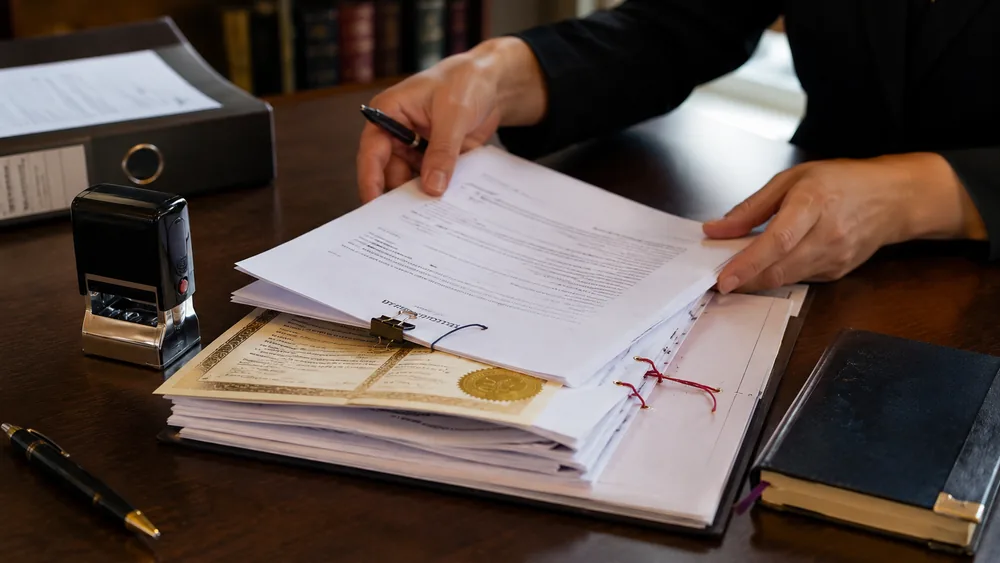
A client needs a translated power of attorney recognized in Mexico. Or a corporate resolution accepted in Spain. Or a birth certificate filed with a court in Brazil. Someone asks whether the translation needs to be notarized, apostilled, or both, and the answer determines whether the document is accepted or bounced back weeks later.
Here is the part that surprises most people. Notarization and an apostille are two different steps, they authenticate two different things, and neither one certifies that the translation is accurate. That is a third, separate thing. Getting the order wrong is the most common reason a translated document fails abroad.
What does notarization actually certify?
It certifies the identity of the person signing, and that they signed in the notary’s presence. That is the whole job.
When a translator signs a certificate of accuracy in front of a notary, the notary is attesting that the translator is who they say they are and that the signature is genuine. The notary is not reading the translation. The notary is not evaluating whether the translator is competent. The notary is not comparing the translation to the source. Most notaries could not do that even if asked, because they do not speak the language pair.
So a notarized translation means: a real, identified person signed a statement about this translation. It does not mean a government reviewed the translation, and it does not make the translation correct.
What does an apostille certify?
An apostille authenticates the signature and seal of the public official on the document, so that a foreign country will accept it without further legalization.
It comes from the Hague Convention of 5 October 1961 Abolishing the Requirement of Legalisation for Foreign Public Documents, which has 130 contracting parties. The point of the treaty is to replace a slow chain of consular legalization with one certificate that every member country accepts.
Critically, an apostille on a notarized translation authenticates the notary’s commission, not the translation. It is one more layer up the chain of custody: the state confirms that the notary who signed was a validly commissioned notary. It says nothing about language, accuracy, or the translator’s credential.
So who certifies that the translation is actually accurate?
The translator does, in the certificate of accuracy, and that is the only document in the stack that speaks to accuracy at all.
That is why the certificate of accuracy has to name the translator, state the language pair, identify the source document, and attest to competency. If the certificate is thin and the packet is heavily notarized and apostilled, the packet looks official and still cannot defend the one thing that matters if the translation is challenged.
Think of it as three separate questions, answered by three separate parties:
- Is the translation accurate and complete? The translator answers, on the certificate of accuracy.
- Did a real, identified person sign that certificate? The notary answers.
- Was that notary validly commissioned by the state? The apostille answers.
Skip the first and the other two are authenticating a signature on an unreliable document.
Does a translated document always need an apostille?
No. It depends on the destination country and on what the receiving institution asks for.
- Destination is a Hague Convention country: an apostille is generally the path, and consular legalization is not required.
- Destination is not a party to the Convention: an apostille does not apply. The document usually needs consular legalization through that country’s embassy or consulate, which is a longer chain.
- Destination is inside the United States: neither is typically required for a court filing or a USCIS submission. USCIS requires a certified translation, not a notarized or apostilled one.
Check the current status table before assuming. Membership changes, and a country that was not a party three years ago may be one now.
Which document gets the apostille, the original or the translation?
That depends on what the receiving party asked for, and it is worth asking explicitly rather than guessing.
Sometimes the underlying public document gets the apostille (a birth certificate, a court order, a corporate filing) and the translation rides along as an attachment. Sometimes the notarized translator certificate gets the apostille. Sometimes both. Getting this wrong is the single most common cause of a rejected packet, because the receiving institution is looking for the apostille on a specific page and it is on a different one.
Ask the receiving party, in writing, which document they need apostilled. Then build the packet to match.
Who issues an apostille in California?
The California Secretary of State issues apostilles for documents notarized by California notaries and for documents signed by California public officials. Federal documents are handled through the U.S. Department of State instead.
That distinction matters for planning. A translated state-court judgment and a translated federal-court judgment do not go to the same authenticating authority, and building both into one timeline without checking will cost you a deadline.
What should attorneys verify before the packet ships?
- Destination country and its Convention status. Apostille or consular legalization. Confirm before starting, not after.
- Which page needs the apostille. Ask the receiving institution in writing. Do not infer.
- The certificate of accuracy is real. Named translator, credential, language pair, source document identified. Notarization does not fix a weak certificate.
- The notary is commissioned in the right state. A California apostille only covers a California notary. If the translator notarized in another state, the apostille has to come from that state.
- Timeline includes the authentication step. Apostille processing is a separate queue with its own turnaround. Build it into the deadline from day one.
- Language requirements at the destination. Some institutions want the translation done in-country, or by a translator on an approved list. Ask before you translate.
Every item is a question you can answer at intake in a few minutes. Every one of them, missed, costs weeks.
Bottom line
Notarization authenticates a signature. An apostille authenticates the notary. Only the certificate of accuracy speaks to whether the translation is right, and it is the one that gets the least attention because it looks like the least official page in the packet.
For firms sending certified document translation across a border, the working order is: get an accurate translation from a credentialed translator, get a certificate of accuracy that names them, notarize it if the destination requires, then apostille if the destination is a Convention country and the receiving party asked for it. Build the packet in that order and it holds up. Build it backward and the most authenticated document in the file can still be the one that fails.
Kaplan Interpreting Services provides certified document translation for law firms across California and nationally, with notarization and apostille coordination handled on request and the translator’s credential named on every certificate. Related reading: what belongs on a certificate of accuracy, confidential translation for in-house counsel, and certified patent translation for IP counsel.
Contact us with the source language, destination country, document type, and deadline, and we will confirm the translation, the certificate, and the authentication path before the packet leaves the office.

CEO & Founder
Born in Dallas, Texas, Alexandra grew up surrounded by Spanish, English, Arabic, and Italian. After moving to Venezuela, Spanish became her primary language. She holds a Master's in Healthcare Administration from Washington University in St. Louis and is a California court certified and medical interpreter.
She founded Kaplan Interpreting Services after seeing an industry that treated interpreters as interchangeable and clients as ticket numbers. She built a protocol-driven operation where every interpreter is hand-selected and credentialed for the specific setting, every client has a dedicated point of contact, and risk management is built into every assignment.
Her career reached a historic milestone when she interpreted the conversation between President-elect Biden and Pope Francis. That assignment, along with engagements for Nike and the Summit of the Americas, set the standard for every client engagement that followed.
"The same protocols that protected that historic conversation now protect every assignment we handle."