
Certified Patent Translation: What IP Counsel Should Verify Before Sending a Foreign Filing
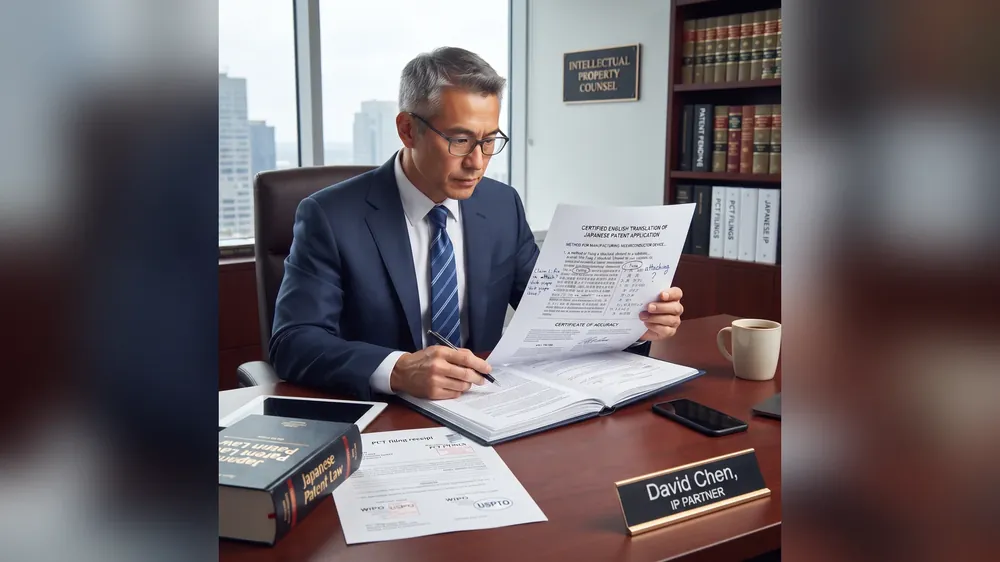
An IP partner is signing off on a national-stage entry in the U.S. for an invention that started life as a Japanese application. The drafting was done in Japanese. The PCT application was filed at WIPO in Japanese. The certified English translation is on his desk, prepared by the firm’s usual translation vendor. He notices, on the second read, that the lead claim’s verb has shifted from a specific action to a more general one. The original Japanese claim covered a method of fixing a structural element to a substrate. The English claim covers a method of attaching it. In Japanese patent practice, the verb that was used carries the specificity. In English, the verb that was chosen does not.
He calls the vendor. The vendor explains the translator preferred a more readable English verb. The IP partner explains that the readability gain just opened the claim to prior art that the specific verb would have walked around.
This is what certified patent translation is actually about. It is not a document-conversion task. It is the last edit before a claim becomes the version the examiner reads, the prior art search hits, the litigator argues, and a competitor designs around.
What “Certified Patent Translation” Actually Means
When the translation is wrong, the IP counsel finds out in an office action, a competitor’s design-around, or an invalidation proceeding. By then, the filing language is already the record. That is the consequence the procedural rules exist to prevent.
A certified patent translation is a translation prepared and signed by a qualified translator, and depending on the jurisdiction, accompanied by a translator’s affidavit or declaration, confirming the rendering is accurate and complete. For U.S. national-stage filings, 37 CFR § 1.52(d) governs the form, and USPTO patent procedure rules require an English translation when the original was filed in another language. For PCT applications, WIPO’s PCT regulations set the framework for when and how translations are required.
The certification is procedural. The quality of the underlying translation is not. A signed certificate does not guarantee that the patent translation services behind it understood the technical field, the claim drafting conventions of the source language, or the way the U.S. examiner is going to read the result. The best patent translation companies treat the translator as a co-drafter inside the source-language conventions, not as a documentary scribe.
What Goes Wrong, by Filing Language
The four languages that appear most frequently in foreign patent translation work are Japanese, Chinese, German, and Korean. Each fails in a different way.
Japanese. The structural problem in the opening scenario is the most common Japanese-to-English failure: a translator who chooses readability over claim scope. Japanese patent drafting compounds verbs with specific connotations that English does not carry naturally. A translator without subject-matter and claim-drafting fluency will smooth them out and shift scope without realizing it. The same risk surfaces in passive constructions, where Japanese leaves the actor ambiguous and English forces a choice.
Chinese. Chinese patent applications have grown faster than the bench of translators who can render them competently into U.S. claim language, particularly in biotech and semiconductor work. The recurring failure is terminology drift across the specification: the same compound, mechanism, or device rendered three different ways in three sections. A U.S. examiner reads the specification as inconsistent. Biotech patent translation in particular needs a translator whose technical vocabulary matches the application, not a generalist working from a general science background.
German. German is the language where the specification is usually well-drafted in the source, and the translator’s job is to preserve precision rather than improve it. The recurring failure is the opposite of the Japanese one: translators over-literalize a German construction that does not work in English claims, producing claim language that no U.S. examiner would draft and that creates ambiguity at exactly the point a German-language patent attorney chose to be precise.
Korean. Korean patent translation work is smaller in volume than Japanese or Chinese but technically demanding, particularly in mobile, display, and consumer-electronics filings. The recurring failure is term-of-art mismatch: a Korean technical term has a specific U.S.-industry equivalent, and the translator who does not know the U.S. equivalent invents a phrase the examiner has not seen before.
The pattern across all four languages is the same. A certified patent translation reads as if a U.S. patent attorney drafted it. A weak one reads as if a translator processed it.
What to Verify Before You Send the Filing
Three questions separate intellectual property translation services that hold up at examination from ones that do not.
“Who is translating the claims, and what is their technical field?” A biotech filing should be translated by a translator with a biotech background, not a generalist. An electronics filing should be translated by someone who knows the U.S. technical vocabulary in that sector. The translator’s name and field should be on the assignment confirmation before any work begins, not produced at delivery if asked.
“How are inconsistencies between the specification and the claims reconciled, and by whom?” The right answer is: the translator flags any divergence to a senior reviewer who is a U.S. patent professional or has worked alongside one for years. The wrong answer is a one-pass translation with no internal review.
“What is the certificate of accuracy backed by, beyond a signature?” The signature is required. The procurement question is what stands behind it: a documented quality process, named reviewers, internal terminology controls, the kind of structure professional legal and patent translations operate inside, not a sole-translator handoff.
For foreign patent translation work where confidentiality is also a constraint, including cross-border M&A, sealed proceedings, and pre-publication filings, the procurement standard layers further. Confidential translation services in those situations should also document chain of custody, NDA execution at the agency level, and translator access controls. The translation question and the confidentiality question are not separate decisions.
The Bottom Line
A patent filing translation is the version of the application the examiner reads, the prior art search hits, and the litigator argues. When that version is wrong, the IP counsel finds out months later in an office action or a competitor’s design-around. By then, the claim language is already the record.
Certified patent translation services done correctly treat every claim as if the translator is the last person who can protect the scope before it is fixed in the filing. The ones that do not treat it as document conversion and leave the exposure for someone else to discover.
If you have PCT or U.S. national-stage filings in Japanese, Chinese, German, Korean, or other filing languages, contact us with the technical field, the deadline, and the confidentiality posture. We will scope the translator, confirm their field, and structure the review before anything moves.

CEO & Founder
Born in Dallas, Texas, Alexandra grew up surrounded by Spanish, English, Arabic, and Italian. After moving to Venezuela, Spanish became her primary language. She holds a Master's in Healthcare Administration from Washington University in St. Louis and is a California court certified and medical interpreter.
She founded Kaplan Interpreting Services after seeing an industry that treated interpreters as interchangeable and clients as ticket numbers. She built a protocol-driven operation where every interpreter is hand-selected and credentialed for the specific setting, every client has a dedicated point of contact, and risk management is built into every assignment.
Her career reached a historic milestone when she interpreted the conversation between President-elect Biden and Pope Francis. That assignment, along with engagements for Nike and the Summit of the Americas, set the standard for every client engagement that followed.
"The same protocols that protected that historic conversation now protect every assignment we handle."