
A $27 Million Lawsuit Over One Mistranslated Lyric: What The Lion King Case Should Teach Attorneys About Translation on the Record
A comedian said the opening chant of Circle of Life translates to “look, there’s a lion.” The clip went viral. Four months later, the composer who wrote that chant is suing him in federal court in California for $27 million.
That is the headline in NBC News and Variety. Grammy-winning South African composer Lebohang Morake filed a federal civil complaint on March 16, 2026 against comedian Learnmore Jonasi. The complaint says the viral translation is false, that Jonasi presented it as fact instead of as a comedy bit, and that the misrepresentation is interfering with Morake’s business relationships with Disney and his royalty income. The complaint seeks $20 million in actual damages and $7 million in punitive damages.
The correct translation matters here. The chant “Nants’ingonyama bagithi Baba” is Zulu for “there comes a lion, oh father,” used in the song as a royal proclamation. Morake’s lawyers acknowledge that the noun for lion can literally translate to “lion.” Their argument is that Jonasi stripped the royal register out of it and presented the flattened version as authoritative.
The case is entertainment news. It is also a very clean fact pattern for anyone who works with translated material on the record.
The legal question the case actually poses
The complaint is asking a federal court to decide whether a translation that a defendant presented “as factual knowledge with misguided authenticity” is entitled to First Amendment protection for parody. The answer is not obvious, because the framing of how a translation is presented can affect how a court treats the speech.
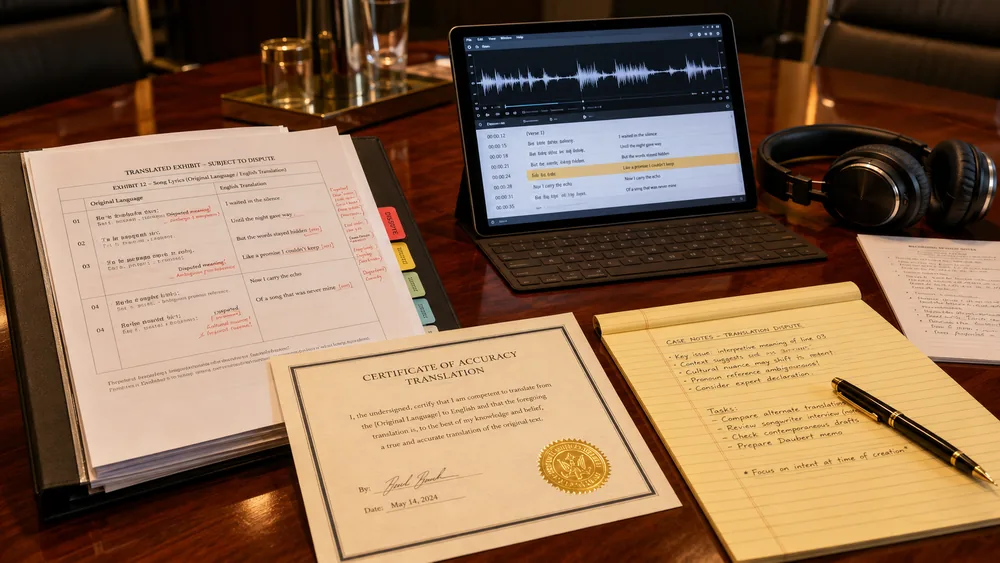
That question, in a courtroom, is going to look familiar. It is the same question that comes up when a translated exhibit is offered without a certificate of accuracy, when a deposition interpreter renders a phrase in a way the deponent later disputes, or when a bilingual family member steps in to interpret at an interview and the resulting statement gets offered against the client. In each of those situations, someone is presenting a translation as authoritative. The question the record has to answer is whether the presentation is defensible.
Where this shows up in a normal caseload
Most cases will never involve a Grammy-winning composer or a Disney soundtrack. Every case involving a limited English proficient client, a foreign-language document, or a witness whose testimony is going on the record through an interpreter has a version of the same question. Who is doing the translating? What credential does that person hold? What documentation exists to defend the translation if it is challenged?
A short list of the places where the question surfaces:
- Translated exhibits. A contract in Mandarin, an email chain in Spanish, a WhatsApp thread in Arabic. If it goes into evidence, a certified translation with a certificate of accuracy is the version that holds up. A translation produced by a bilingual paralegal or an AI tool is a version that opposing counsel can put on the stand and ask questions about.
- Deposition transcripts. The interpreter’s rendering is the version the court reporter takes down. If the deponent later challenges a rendered phrase, the credential and preparation of the interpreter is what defends the record. A court-certified interpreter matched to the language and venue can defend the record. An interpreter selected on price and availability may not be able to.
- Client interviews and intake. A family member offered as an interpreter is a very common shortcut. It is also a common way to end up with a client statement that cannot be authenticated later. USCIS, immigration courts, and criminal proceedings all have rules about who can serve, and the rules exist because a relative with a stake in the outcome is not a neutral speaker.
- Expert reports translated for a jury. A translated expert report reads to the jury as the expert’s words. If the translation drifts from the original, the expert is going to have to defend testimony they did not exactly give.
Each of these is a situation where a translation is being presented as authoritative. Each is a situation where the record depends on the presentation being defensible.
What the Morake complaint gets right that firms often get wrong
The complaint treats the translation as a fact in dispute, not as background context. That is the framing that puts translation into the center of the record instead of leaving it in the footnotes. Firms that only ask about interpretation on the morning of a hearing are treating translation as background. Firms that build the credential and documentation question into intake are treating translation the way the complaint does: as a fact that has to be defensible.
A few practical moves that follow from that framing:
- On any translated exhibit, ask for the certificate of accuracy before it goes into the record. If there is no certificate, get one from a certified legal translator before the deadline.
- On any deposition interpreter, ask for the court certification, the language pair, and the deposition experience count. Ask before the deposition, not after opposing counsel raises it.
- On any client interview, rule out family and staff as interpreters when the statement is going to be used in a proceeding. Book a neutral, credentialed interpreter even for what looks like a routine intake.
- On any recording that will be transcribed and translated, confirm who is doing both the transcription and the translation, and confirm that they are not the same person doing both without an independent review.
The Lion King complaint is not going to change how federal courts treat parody. It is going to make one more part of the public conversation that translation, presented as authoritative, has legal consequences. Attorneys who already treat translation as evidence and not as service will not be surprised by the outcome, whatever it is. Attorneys who treat translation as a scheduling problem might be.
Contact us if you want a credentialed interpreter or a certified translation on a matter where the record has to hold up.

CEO & Founder
Born in Dallas, Texas, Alexandra grew up surrounded by Spanish, English, Arabic, and Italian. After moving to Venezuela, Spanish became her primary language. She holds a Master's in Healthcare Administration from Washington University in St. Louis and is a California court certified and medical interpreter.
She founded Kaplan Interpreting Services after seeing an industry that treated interpreters as interchangeable and clients as ticket numbers. She built a protocol-driven operation where every interpreter is hand-selected and credentialed for the specific setting, every client has a dedicated point of contact, and risk management is built into every assignment.
Her career reached a historic milestone when she interpreted the conversation between President-elect Biden and Pope Francis. That assignment, along with engagements for Nike and the Summit of the Americas, set the standard for every client engagement that followed.
"The same protocols that protected that historic conversation now protect every assignment we handle."