
The EEOC's Walmart Interpreter Case: What It Means for Meetings, Investigations, and HR Records
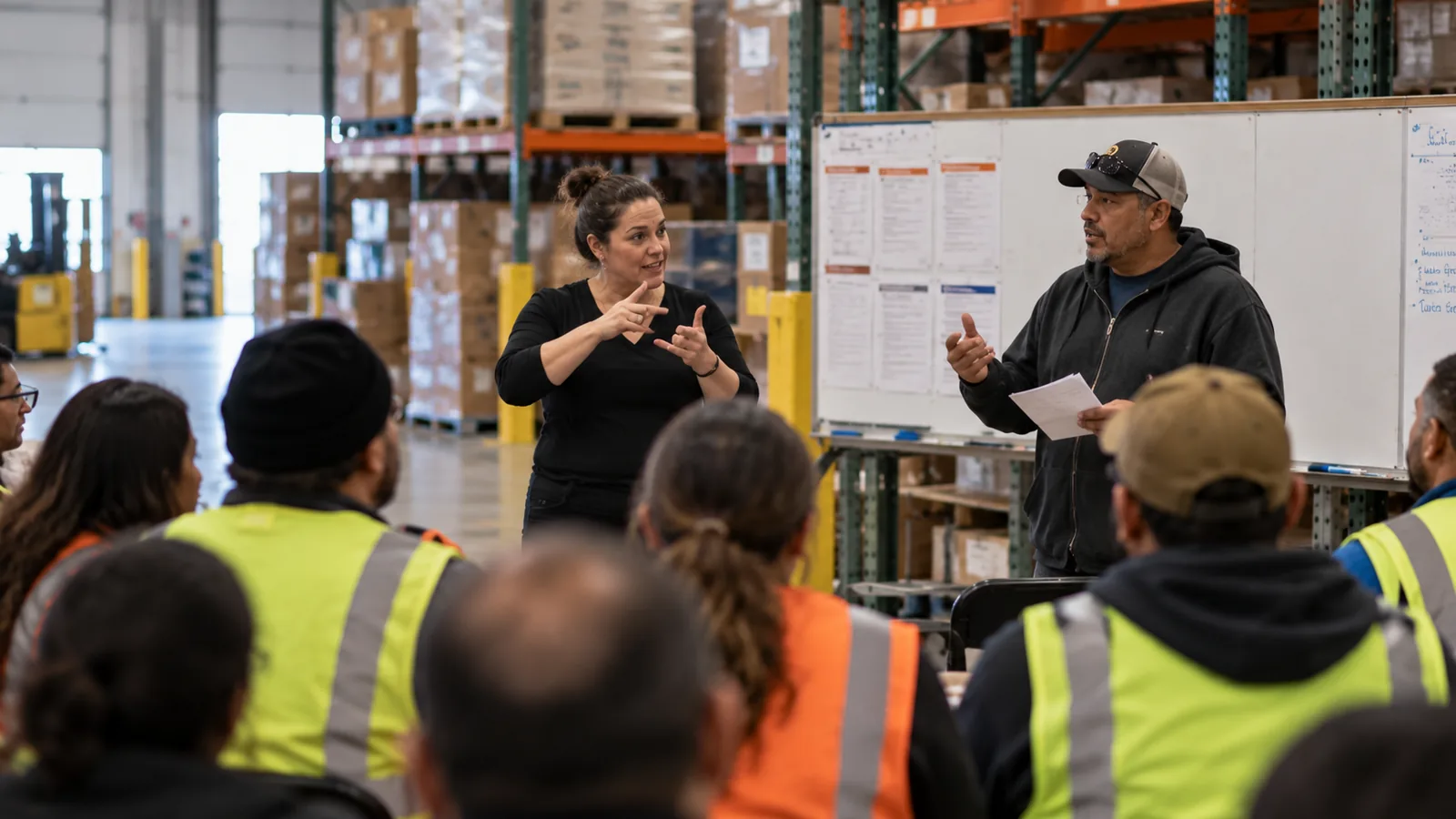
A deaf stocker at a Walmart in Fredericksburg, Virginia spent six years asking for a sign language interpreter at the daily staff meeting. In the words of the complaint the Equal Employment Opportunity Commission announced on October 1, “These services were not and are still not provided.” The agency, which enforces federal workplace discrimination law, has sued Wal-Mart Stores East, LP in the United States District Court for the Eastern District of Virginia, case number 3:26-cv-01037.
What the Complaint Describes
The employee works as a stocker. His first language is American Sign Language. The meetings at issue are the mandatory briefings that open each shift, where, as reported from the complaint, attendance is taken, tasks are assigned, delivery information is passed on, and safety updates are given. The agency says he asked more than one supervisor, over several years, and that management supplied written notes for a period. The complaint’s position is that the notes did not allow him to participate.
In August 2023 the Virginia Department of Aging and Rehabilitation Services wrote to the company with information about video remote interpreting, which delivers an interpreter over a video connection rather than in the room. The agency alleges no accommodation followed.
These are allegations and nothing has been decided. The EEOC brings a case to court when conciliation, its informal resolution stage, does not produce an agreement, so the company’s account of the same facts is not yet on the public record.
The Statute Names Interpreters
Employment counsel will recognize the framework, but the specific word is worth reading in the original. The Americans with Disabilities Act defines reasonable accommodation at 42 U.S.C. 12111(9) to include “the provision of qualified readers or interpreters, and other similar accommodations for individuals with disabilities.” Interpreters are not an inference drawn from the statute. They are listed in it.
The counterweight is undue hardship, defined in the same section as “an action requiring significant difficulty or expense.” Melinda Dugas, regional attorney for the EEOC’s Charlotte District, framed the agency’s view of where that line tends to fall: “Providing access to a sign language interpreter is often a reasonable accommodation that can be provided by an employer without experiencing undue hardship.”
The Routine Meeting Is the Exposure
The detail worth noting is what the meeting was. Not a disciplinary hearing, not a termination, not a deposition. A fifteen to thirty minute briefing that happens every day and that nobody would describe as a legal event.
Recurring, low-ceremony meetings are the ones that get handled informally, because each one on its own looks too small to book an interpreter for. The complaint describes written notes, which is the usual informal substitute. Multiplied across six years, the agency’s position is that the informal substitute became the accommodation.
What Changes for Counsel Advising Employers
The same analysis reaches further than the shift meeting, and the place it lands hardest is the workplace investigation.
An investigation interview conducted in a language the employee does not fully command produces a written summary that the employer will later rely on. If the interview was carried by a bilingual colleague, a supervisor with some Spanish, or a family member brought in to help, three problems arrive together. The employee’s account may not be what the summary says. The colleague now knows the substance of a confidential matter. And the person who carried the words works for one of the parties, which is the first thing the other side will ask about.
An interpreter engaged for the job renders what was said rather than summarizing it, has no stake in the outcome, and is not an employee whose own standing turns on it. None of that is a courtesy. It is what helps the investigation file hold up if the matter is litigated later.
What to Confirm
Four things, each of which is a record an employer either has or does not have.
Identify which recurring meetings in the organization carry information employees are expected to act on, and treat those as accommodation territory rather than as logistics.
Record how each accommodation request was made and answered, by date and by name. The complaint’s arithmetic, six years and at least five supervisors, is a records problem as much as an access problem.
Separate the interpreter from the parties on any investigation or disciplinary interview. Use someone outside the reporting line.
Decide on remote or in-person in advance. Video remote interpreting answers the cost and scheduling objection for short recurring meetings, which is the objection the Virginia agency was addressing in its 2023 letter.
An employer that can show when the request came in, what was offered, and who interpreted is in a very different position from one reconstructing six years of informal practice after a complaint is filed. These steps apply regardless of which agency a firm or its client ultimately works with.
Kaplan Interpreting Services provides American Sign Language interpreters and spoken-language interpreters for workplace meetings, investigations, and corporate sessions, on site or by video. For a deposition or hearing where the witness is deaf, see our guidance on when a case needs a certified deaf interpreter. Contact us with the setting, the language, the frequency, and whether the session is on site or remote.
Not legal advice. The EEOC’s allegations have not been tested in court. Employment standards vary by jurisdiction.

CEO & Founder
Born in Dallas, Texas, Alexandra grew up surrounded by Spanish, English, Arabic, and Italian. After moving to Venezuela, Spanish became her primary language. She holds a Master's in Healthcare Administration from Washington University in St. Louis and is a California court certified and medical interpreter.
She founded Kaplan Interpreting Services after seeing an industry that treated interpreters as interchangeable and clients as ticket numbers. She built a protocol-driven operation where every interpreter is hand-selected and credentialed for the specific setting, every client has a dedicated point of contact, and risk management is built into every assignment.
Her career reached a historic milestone when she interpreted the conversation between President-elect Biden and Pope Francis. That assignment, along with engagements for Nike and the Summit of the Americas, set the standard for every client engagement that followed.
"The same protocols that protected that historic conversation now protect every assignment we handle."