
Certified Deaf Interpreter: How to Know Your Case Needs One Before the Deposition
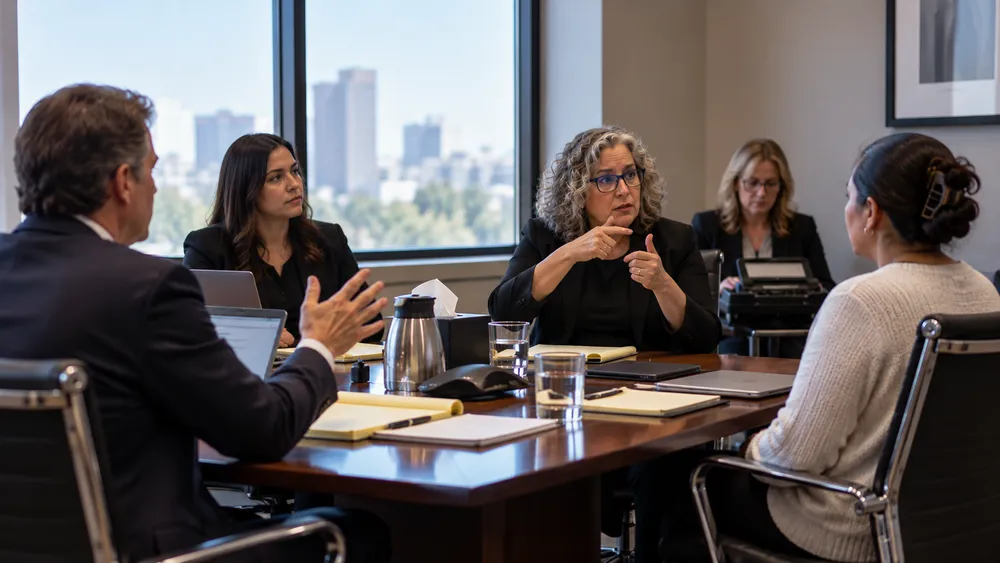
When a deaf witness uses sign language in a legal proceeding, the standard arrangement is a hearing interpreter certified in American Sign Language. That interpreter works between spoken English and ASL, rendering what is said into sign and what is signed into speech.
The problem is that not all deaf witnesses sign in standard ASL. Some use signs developed within their own family. Some learned to sign in another country. Some have a regional or generational signing style that differs significantly from the standard. When a witness signs in a way that a hearing interpreter cannot fully follow, one interpreter is not enough. That is when a case needs a Certified Deaf Interpreter. The CDI and the hearing ASL interpreter work together as a team, each handling a different part of the communication.
A Certified Deaf Interpreter, known as a CDI, is a deaf or hard of hearing person certified as an interpreter by the Registry of Interpreters for the Deaf (RID), the national credentialing organization for sign language interpreters. According to RID’s standard practice paper on the use of a CDI, a CDI brings extensive knowledge of deafness and Deaf culture and may have specialized training in gesture, mime, props, and drawings to reach communication that falls outside standard ASL. A CDI and a hearing ASL interpreter work together as a team: the CDI works directly with the deaf witness, and the hearing interpreter works between the CDI and the hearing people in the room. At a deposition, that is counsel and the court reporter.
RID’s 2024 Professional Practice Paper on Deaf interpreters notes that not every Deaf interpreter is certified. Those certified by RID hold the CDI, which the paper calls the only nationally recognized entry-level interpreting credential for Deaf interpreters. Some states, including Utah and Texas, provide their own certification for Deaf interpreters. When your firm requests one, ask for a CDI by name and check what your venue’s rules call for.
The hard part is timing. Finding out halfway through a deposition that the arrangement is not working costs you the session and leaves the transcript open to challenge. The goal is to have the right team in place before testimony starts.
When a Case Needs a Certified Deaf Interpreter
Knowing when to use a CDI starts with RID’s 1997 standard practice paper. It describes when one may be needed: when a deaf person’s communication mode is so unique that hearing interpreters cannot adequately access it. The paper lists situations that may involve people who:
- use non-standard signs or gestures, often called “home signs,” that are unique to a family
- use a foreign sign language
- have minimal or limited communication skills
- are deaf-blind or deaf with limited vision
- use signs particular to a given region, ethnic group, or age group
- have characteristics reflective of Deaf culture that hearing interpreters are not familiar with
For a firm, those categories turn into questions about the witness. Did they grow up without formal ASL instruction? Did they learn to sign in another country? Is their signing tied to one region or one generation? Do they have any vision loss? A yes to any of these is a good reason to bring up a CDI early.
How the CDI and Hearing Interpreter Work Together
The 1997 paper describes a CDI as often working as a team member with a certified hearing interpreter. The CDI passes the message between the witness and the hearing interpreter. The hearing interpreter passes it between the CDI and the hearing parties. At a deposition, that means counsel and the court reporter.
The paper describes this as resembling a relay, but more than one. Each interpreter takes in the message and processes it linguistically and culturally before passing it on. In harder situations, the two interpreters may work out the witness’s meaning together and agree on their best interpretation before it reaches the hearing side. Plan for that step when you set the deposition schedule.
This is a different setup from team interpreting for spoken language proceedings, where two interpreters trade off to manage fatigue over a long session. In a CDI team, both interpreters work at the same time, and each has a different job.
For a deaf-blind witness, the paper describes the CDI taking in the message visually and passing it on through touch or at close visual range, processing it first and then delivering it in the mode the witness understands most easily.
Spotting the Need Before the Deposition Starts
RID’s 2024 paper recommends consulting a Deaf interpreter when the interpreting team is put together. For a deposition, that means raising the question on the intake call, at the same point you would book any other interpreter. Ask whoever knows the witness’s communication best:
- How does the witness communicate day to day, and with whom? Signs used only inside the family are a flag.
- Where and when did they learn to sign? A foreign sign language, or signs tied to one region or generation, can point to the need for a CDI.
- Do they have any vision loss?
- In past meetings with an interpreter, did anyone notice gaps in understanding?
Two things can make this conversation easier. First, the 2024 paper notes that hiring a Deaf interpreter is not an evaluation of any specific person’s linguistic competence. Asking for a CDI says nothing negative about your client. Second, the hearing interpreter on your matter is a good person to ask. The 2024 paper notes that hearing interpreters can and do request a Deaf interpreter when they recognize the need.
These questions apply to hearings and client meetings as well. Legal interpreting in ASL carries the same stakes for the record wherever it happens.
Booking a CDI Team
Staffing a CDI at intake is easier than scrambling for one mid-session. Kaplan Interpreting Services raises the CDI question at intake for ASL bookings, so the team is in place before testimony starts. When you request a quote, tell us what you know about how your witness communicates. We will match the team to the case.
Not legal advice. Standards vary by jurisdiction. This post describes RID practice papers and general interpreting practice. Check the interpreter rules of your venue for a specific proceeding.

CEO & Founder
Born in Dallas, Texas, Alexandra grew up surrounded by Spanish, English, Arabic, and Italian. After moving to Venezuela, Spanish became her primary language. She holds a Master's in Healthcare Administration from Washington University in St. Louis and is a California court certified and medical interpreter.
She founded Kaplan Interpreting Services after seeing an industry that treated interpreters as interchangeable and clients as ticket numbers. She built a protocol-driven operation where every interpreter is hand-selected and credentialed for the specific setting, every client has a dedicated point of contact, and risk management is built into every assignment.
Her career reached a historic milestone when she interpreted the conversation between President-elect Biden and Pope Francis. That assignment, along with engagements for Nike and the Summit of the Americas, set the standard for every client engagement that followed.
"The same protocols that protected that historic conversation now protect every assignment we handle."