
Asylum Interview Interpreters: What Counsel Must Confirm Before the Date
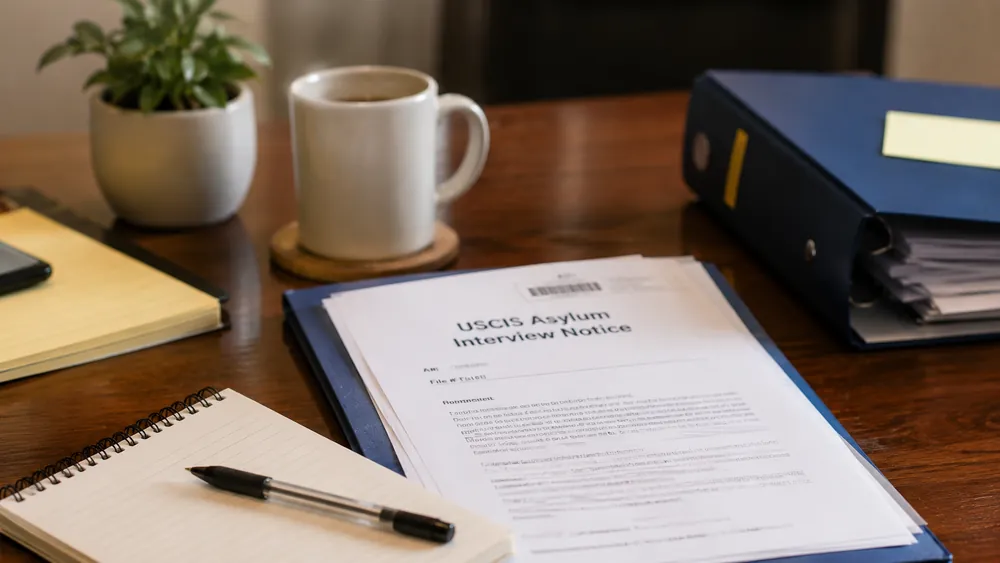
USCIS is explicit: an applicant who cannot proceed in English must bring their own interpreter to an affirmative asylum interview. The agency does not provide one, with a narrow exception for applicants who are deaf or hard of hearing. The interpreter must be fluent in English and in a language the applicant speaks fluently, and must be at least 18 years old. There is no requirement that the interpreter be a professional or certified. A friend or family member can serve, as long as they are not disqualified and genuinely meet the fluency standard.
Can a Friend or Family Member Interpret at My USCIS Asylum Interview?
Yes, within limits, and the limits are where the exposure sits.
Who Cannot Serve as the Interpreter
Two categories of people are specifically disqualified: representatives or employees of the government of the applicant’s country of nationality, and individuals with a pending asylum application who have not yet been interviewed. A spouse or petitioner can never serve as the interpreter under any circumstance. Officers also have broad discretion to disqualify anyone they judge to be biased or underqualified, including friends, adult children, or community members, even mid-interview.
The second disqualification is the one that catches people. A recently arrived applicant’s closest contact is often someone from the same community who went through the same process and may still have a pending application. That person is disqualified, and the applicant is unlikely to know it without being told.
Allowed Is Not the Same as Adequate
A friend or family member who is genuinely fluent in both languages can legally serve. The question is whether fluency in conversation is the same thing as interpreting a two-hour interview about persecution, trauma, and credible fear, accurately, in real time, in both directions. It usually is not. A bilingual friend simplifies, summarizes, softens, and fills in gaps without realizing it. They also have a stake in the outcome, which affects what they render and how.
A professional interpreter renders the testimony accurately, including the hesitations and the hard parts. They have no stake in the outcome and no instinct to smooth things over.
There Is Someone Listening
What most applicants do not know is that USCIS uses contract interpreters who listen to asylum interviews by phone while the interview is in progress. Their job is not to interpret. It is to monitor the accuracy, completeness, and neutrality of the applicant’s interpreter in real time. They take an oath at the start and are required to flag errors to the officer immediately.
If the officer decides the interpreter is not competent or neutral, they can dismiss that interpreter on the spot. USCIS will attempt to bring in a contract interpreter to finish. If none is available, the interview is terminated and rescheduled, and that rescheduling is formally recorded as a delay caused by the applicant. As of August 2026, rescheduling requires showing exceptional circumstances, a higher bar than before. Any employment authorization processing is also paused while the applicant waits.
What a Rescheduled Interview Actually Costs
Before deciding to bring a friend, it is worth running the full calculation. A rescheduled interview means a second date and a second trip. As of May 2026, attorneys are required to be physically present at asylum interviews, so a rescheduled interview also means a second in-person attorney appearance. The money saved by not hiring a professional interpreter can easily be overtaken by the cost of a second hearing date, and the delay goes on the applicant’s record, not the agency’s.
What the 2026 Policy Changes Mean
Two recent changes have raised the stakes on asylum interview preparation.
Effective May 18, 2026, attorneys and accredited representatives, meaning lawyers and qualified non-attorney immigration representatives, may no longer participate remotely in affirmative asylum interviews. Physical presence is now required. Attorney unavailability is generally not good cause to reschedule.
Effective August 21, 2026, rescheduling an asylum interview now requires exceptional circumstances rather than good cause. Together, these changes mean the margin for any last-minute problem at the interview, including an interpreter who gets dismissed, is considerably thinner than it was before.
Immigration Court Is Different
The same applicant often passes through both proceedings, so it is worth keeping the rules straight. In immigration court, the court provides the interpreter. The obligation to bring one applies at the USCIS asylum office stage. An applicant referred from USCIS to removal proceedings will have a court-supplied interpreter there.
What to Confirm Before the Interview
Confirm the specific language the applicant speaks, not just the country they are from, and make sure the interpreter speaks the same variety.
Confirm who is being brought, by name, well in advance, and confirm that person is not disqualified.
Confirm the interpreter is genuinely fluent in both languages, not just conversational, and can work through a full asylum interview.
If no one suitable is available, arrange a professional interpreter before the date arrives, not the week of.
Kaplan Interpreting Services provides professional interpreters for asylum interviews, USCIS appointments, and immigration proceedings, in person and matched by language and variety. Contact us with the language, the asylum office location, the appointment type, and the date, and we will confirm coverage before the interview.
Not legal advice. USCIS policy changes. Verify current guidance before relying on it.

CEO & Founder
Born in Dallas, Texas, Alexandra grew up surrounded by Spanish, English, Arabic, and Italian. After moving to Venezuela, Spanish became her primary language. She holds a Master's in Healthcare Administration from Washington University in St. Louis and is a California court certified and medical interpreter.
She founded Kaplan Interpreting Services after seeing an industry that treated interpreters as interchangeable and clients as ticket numbers. She built a protocol-driven operation where every interpreter is hand-selected and credentialed for the specific setting, every client has a dedicated point of contact, and risk management is built into every assignment.
Her career reached a historic milestone when she interpreted the conversation between President-elect Biden and Pope Francis. That assignment, along with engagements for Nike and the Summit of the Americas, set the standard for every client engagement that followed.
"The same protocols that protected that historic conversation now protect every assignment we handle."