
Immigration Court Interpreters: What Law Firms Should Verify Before the Hearing
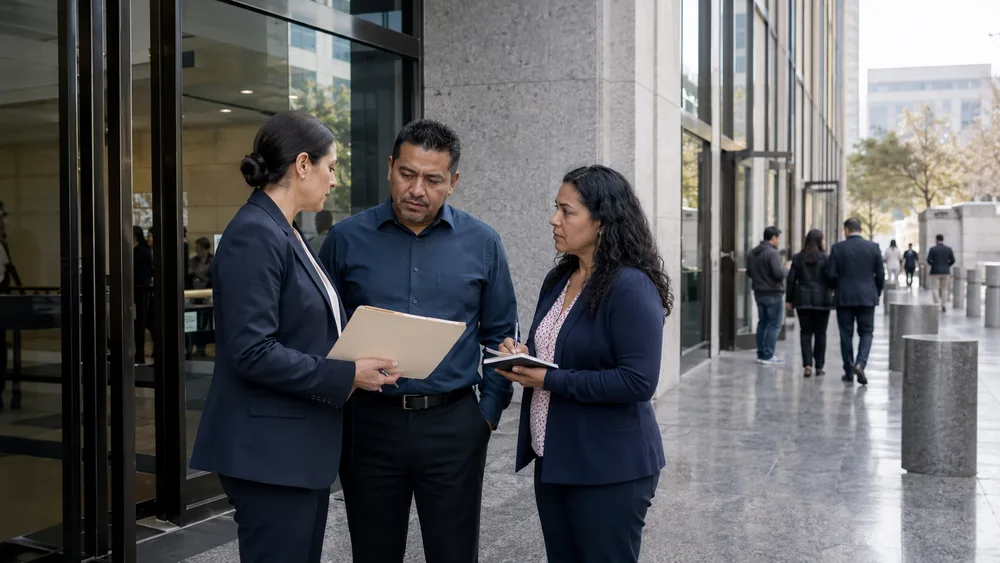
In February 2026, a man named Jordy drove twenty-two hours from Sacramento, California, to Omaha, Nebraska, for a hearing at the Omaha Immigration Court, as Nebraska Public Media reported in a June 17, 2026 piece by Justin Diep. He shared the drive with a friend in a rented Toyota RAV4, napped at a budget motel across the river in Council Bluffs, Iowa, and arrived ninety minutes before his name was called. His hearing was conducted through an in-person Spanish interpreter. Immigration Judge Matthew Morrissey, who would hear seventy-five cases that single day, moved Jordy’s case to the Sacramento Immigration Court, a fifteen-minute drive from his home. The Nebraska News Service observed 316 cases in the Omaha Immigration Court in that one week alone.
Jordy’s twenty-two-hour drive is the memorable detail. The procurement lesson underneath it is the interpreter. In an immigration court moving at seventy-five cases per judge per day, the interpreter is not a convenience. It is the mechanism by which a non-English-speaking respondent can hear the judge’s questions, understand what is being decided about their status, and answer accurately for the record. For law firms representing non-English-speaking clients in immigration court, that means the interpreter procurement decision runs closer to the outcome than the calendar entry suggests.
What the Interpreter Actually Does in Immigration Court
Federal law requires competent interpretation for respondents who do not speak English in immigration proceedings, and the Executive Office for Immigration Review contracts staff and contract interpreters to cover the volume. In practice, that coverage lands differently across courts. High-volume dockets, unusual languages, and dialect matches for indigenous Latin American languages and West African Francophone languages can strain the staffing model. When the court’s interpreter is present and matched, the record moves. When the coverage is thin or the dialect is off, the record slows or drifts.
Firms representing respondents do not control the court’s interpreter roster. What they can control is how they prepare the client and how they document the language and dialect on their filings and continuance motions. A firm that files “Spanish interpreter needed” on behalf of a Mixteco-Bajo-speaking client from Oaxaca is filing a request that will not solve the actual language barrier. A firm that specifies the language, the region, and, where relevant, the dialect, is filing a request the court can staff correctly.
For anything outside the courtroom itself, including client intake, client preparation, and medical or forensic evaluations tied to the case, the firm is procuring the interpreter directly. Supporting documents are a separate procurement question, and certified legal translation services carry their own credential and certificate requirements. That is where the vetting question stops being theoretical.
What Immigration Firms Should Verify at Procurement
Three questions separate a defensible interpreter engagement in the immigration lane from one that will surface later.
Is the interpreter matched by language, region, and dialect, not just language pair? Immigration clients arrive from every part of Latin America, West Africa, South Asia, the Middle East, and beyond. A Spanish speaker from Guatemala, a Spanish speaker from the Dominican Republic, and a Spanish speaker from central Mexico are not interchangeable in a proceeding where a single mistranslated regional term can raise a credibility question. The confirmation should name the interpreter, the credential, and the dialect they carry, at the point of assignment.
Is the interpreter court-experienced, or courtroom-adjacent? A court-certified interpreter has passed a serious exam. A conference interpreter, a medical interpreter, or a community interpreter is a different credential for a different setting. Immigration hearings, master calendars, and individual merits hearings run on court rhythm and court register. The interpreter should have court experience, and ideally immigration-court experience specifically, because the terminology drift between civil litigation and immigration proceedings is real and it shows on the record.
Is the confidentiality posture documented at the agency level, not the assignment level? Client intake, preparation sessions, and case discussions with an interpreter are privileged. The interpreter should be under a signed non-disclosure agreement at the agency level, not on the assignment sheet, before any conversation begins. The billing record should tie each session to a named interpreter, a documented encounter, and a time window that the firm can reconcile against its own file.
Language and Venue Move Together
The Omaha story ends with the judge moving Jordy’s case to the Sacramento Immigration Court. That move is common and it is worth flagging because it changes the interpreter procurement decision on the firm’s side. A California resident whose case sits in Nebraska needs an interpreter connected to Nebraska proceedings. The same California resident whose case moves back to Sacramento needs California legal interpreting staffed for Los Angeles, Sacramento, San Francisco, or San Diego venue rhythm. The language-by-venue match is not a detail. It is the procurement standard.
For in-person interpretation at immigration master calendars, individual hearings, and client preparation across California immigration courts, the confirmation should specify the venue, the language, the dialect where relevant, the setting (master calendar, individual, credible fear, bond), and the estimated length. Those five inputs are what let a serious agency assign an interpreter who will keep the record intact.
The Bottom Line
Immigration court is moving faster and carrying more per judge than it did five years ago. That pace is not going to reverse. What firms can protect is the layer they procure directly: a credentialed interpreter, matched by language and dialect, court-experienced, under agency-level confidentiality, on a paper trail that reconciles session by session. The firms that keep that standard are the ones whose clients’ testimony reads clearly on the record. The ones that treat interpreter procurement as a calendar entry are the ones whose credibility findings turn on a translation nobody in the room could verify.
Kaplan Interpreting Services provides certified interpreters for immigration master calendar and individual hearings, USCIS interviews, credible fear interviews, and client preparation across Los Angeles legal venues and California-wide, matched by language and dialect. Contact us with the language, dialect where relevant, venue, hearing type, and date, and we will confirm availability and a quote.

CEO & Founder
Born in Dallas, Texas, Alexandra grew up surrounded by Spanish, English, Arabic, and Italian. After moving to Venezuela, Spanish became her primary language. She holds a Master's in Healthcare Administration from Washington University in St. Louis and is a California court certified and medical interpreter.
She founded Kaplan Interpreting Services after seeing an industry that treated interpreters as interchangeable and clients as ticket numbers. She built a protocol-driven operation where every interpreter is hand-selected and credentialed for the specific setting, every client has a dedicated point of contact, and risk management is built into every assignment.
Her career reached a historic milestone when she interpreted the conversation between President-elect Biden and Pope Francis. That assignment, along with engagements for Nike and the Summit of the Americas, set the standard for every client engagement that followed.
"The same protocols that protected that historic conversation now protect every assignment we handle."