
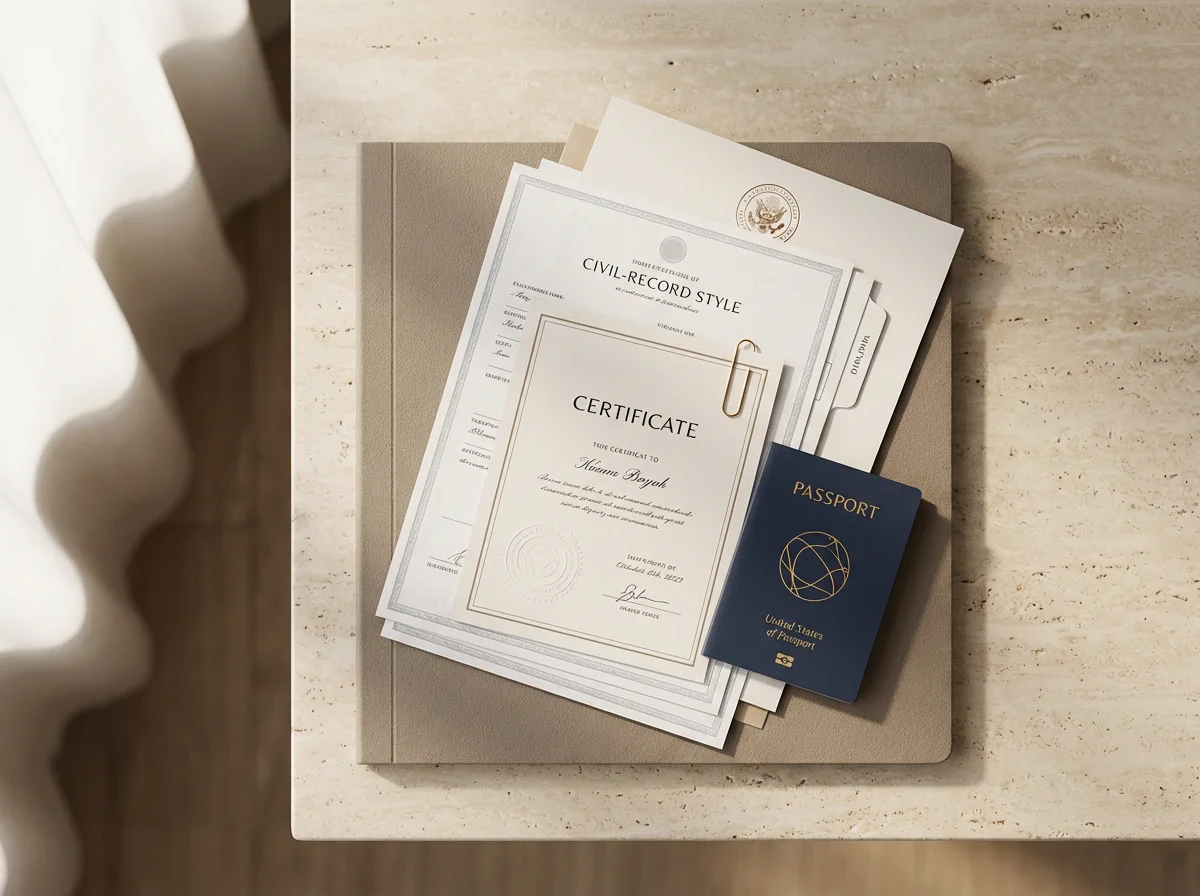
Immigration Document Translation
Certified Immigration
Document Translation
Certified translation of civil records, asylum evidence, credentials, and sponsorship documents for immigration practices, with the complete-document standard and the certification wording that keeps a filing from drawing a Request for Evidence.
What does USCIS require for a translated document?
USCIS requires a complete English translation of the entire document, including seals, stamps, and marginal notations, plus a signed certification stating that the translation is complete and accurate and that the translator is competent to translate. Notarization is not generally required by USCIS, though some consulates ask for it. Kaplan prepares certification in the format the receiving body expects, marks illegible passages rather than guessing, and translates in 200+ languages.
Immigration Translation
Civil Documents & Vital Records
Certified translation of birth, marriage, divorce, and death records, police certificates, and household registers for petitions and adjustment filings. USCIS requires a complete translation of the entire document, including seals, stamps, and marginal notations that are easy to omit.

Immigration Translation
Asylum & Humanitarian Evidence
Translation of country-condition evidence, declarations, medical and psychological evaluations, news reports, and supporting exhibits for asylum, withholding, and humanitarian relief. Sensitive material handled by linguists briefed on the case posture.

Immigration Translation
Employment & Education Credentials
Translation of diplomas, transcripts, professional licences, and employment records supporting employment-based petitions and labour certification. Frequently paired with a credential evaluation, which we can coordinate around rather than duplicate.

Immigration Translation
Financial & Sponsorship Documentation
Translation of bank records, tax filings, property documents, and affidavits of support for family-based petitions and consular processing. Figures, dates, and currency conventions rendered to the format the reviewing officer expects.
Why Kaplan
Built to Survive Adjudication
USCIS-Format Certification
Every translation carries a certificate of accuracy in the format USCIS expects, naming the translator and attesting to competence and completeness, which is the exact wording that prevents a Request for Evidence.
Complete Document, Nothing Omitted
Seals, stamps, marginal notes, and reverse-side content are translated and described. Omitting them is one of the most common reasons a filing draws an RFE.
Consular and Apostille Formats
Where the destination is a consulate or a foreign ministry rather than USCIS, certification is prepared to that body's requirements, including apostille-ready packages.
Built for Caseloads
Immigration practices with recurring filings get a consistent linguist team, a standing intake process, and predictable turnaround, rather than starting over on every matter.
Confidential and Sensitive-Case Aware
Asylum and humanitarian material is handled under strict confidentiality by linguists briefed on the posture of the case, with access limited to the assigned team.
200+ Languages
Certified immigration translation in over 200 languages and dialects, including the rare and regional pairs that routinely appear in asylum and humanitarian matters.
Client Feedback
What Our Clients Say
"They translated the seals and the handwritten notes on the back, which our previous vendor had been skipping. That was the RFE we kept getting."
Carolina D.
Immigration Attorney
"They flagged an illegible date instead of guessing at it. We got a clean copy before filing rather than after the notice."
Henry T.
Managing Attorney
FAQs
Common Questions
What does USCIS actually require for a translated document?
+
USCIS requires a complete English translation of the entire document plus a signed certification from the translator stating that the translation is complete and accurate and that the translator is competent to translate. Notarization is not generally required by USCIS itself, though some consulates ask for it. The two things that most often go wrong are an incomplete translation, where seals and marginal notes were skipped, and a certification that omits the competence statement.
Why do translated documents draw a Request for Evidence?
+
In our experience the recurring causes are incomplete translation and defective certification. Reverse-side content, official seals, stamps, and handwritten marginal notations are part of the document and must appear in the translation, described where they cannot be rendered. A certificate that omits the translator's competence statement, or that is unsigned, will also draw an RFE even when the translation itself is fine.
Do you translate asylum and country-condition evidence?
+
Yes. We translate declarations, country-condition reports, news material, and medical and psychological evaluations for asylum, withholding, and humanitarian filings. This material is assigned to linguists briefed on the posture of the case and handled under strict confidentiality, because the content is frequently traumatic and the source documents are often poor-quality scans of originals obtained under difficult circumstances.
Can you handle a filing deadline or a large caseload?
+
Yes. Practices with recurring filings are set up with a standing intake process and a consistent linguist team, which makes turnaround predictable rather than negotiated each time. For a specific deadline, tell us the date when you send the documents and we confirm a realistic timeline before starting, including same-week availability for many language pairs.
What if the document is a poor-quality scan or partly illegible?
+
We translate what is legible and mark illegible passages explicitly rather than guessing. A translation that quietly invents content in an unreadable field is far more dangerous to a filing than one that flags the gap, because the discrepancy will surface later. Where the illegible portion is material, we will tell you so you can obtain a better copy before filing.
Do you provide notarized or apostille-ready immigration translations?
+
Yes, when the destination requires it. USCIS generally does not require notarization, but consulates and foreign ministries often do, and requirements vary by post. Tell us which body will receive the document and we prepare the certification, notarization, or apostille-ready package to that body's requirements rather than a generic format.
Do you use machine translation for immigration documents?
+
No. A machine rendering cannot carry a certificate of accuracy, which is the entire point of a certified immigration translation. Beyond the formal problem, names, places, and dates transliterated inconsistently across a document set create discrepancies that an adjudicator reads as credibility issues. This work is done by human translators and reviewed.
Do you also provide interpreters for USCIS interviews and immigration court?
+
Yes, and that is a separate service. Translation covers documents; interpreting covers the interview or hearing. See immigration interpreter services for USCIS interviews, asylum interviews, and immigration court, and USCIS interpreting for the interview requirements specifically.
How do I request an immigration document translation quote?
+
Send the documents, the target language, and the receiving body through our online form or by phone at (833) 547-7770. We confirm scope, certification format for that body, and turnaround, and provide a fixed quote before work begins. Immigration practices with ongoing volume can ask about a standing intake process.
Related Immigration Language Services
Filings and interviews run on the same case. Practices that use both keep names, places, and dates consistent between the translated exhibits and what is said in the interview.
Request an Immigration Document Translation Quote
Send your documents and tell us the receiving body. We confirm the certification format and a fixed quote before work begins.