
Vietnamese Translation
Certified Vietnamese
Document Translation
Certified Vietnamese document translation for clinical and patient-facing material, civil records, community and benefits notices, and employment documents, with diacritics verified in the format you will actually use and name conventions held across the filing.
What is certified Vietnamese translation, and why do diacritics matter?
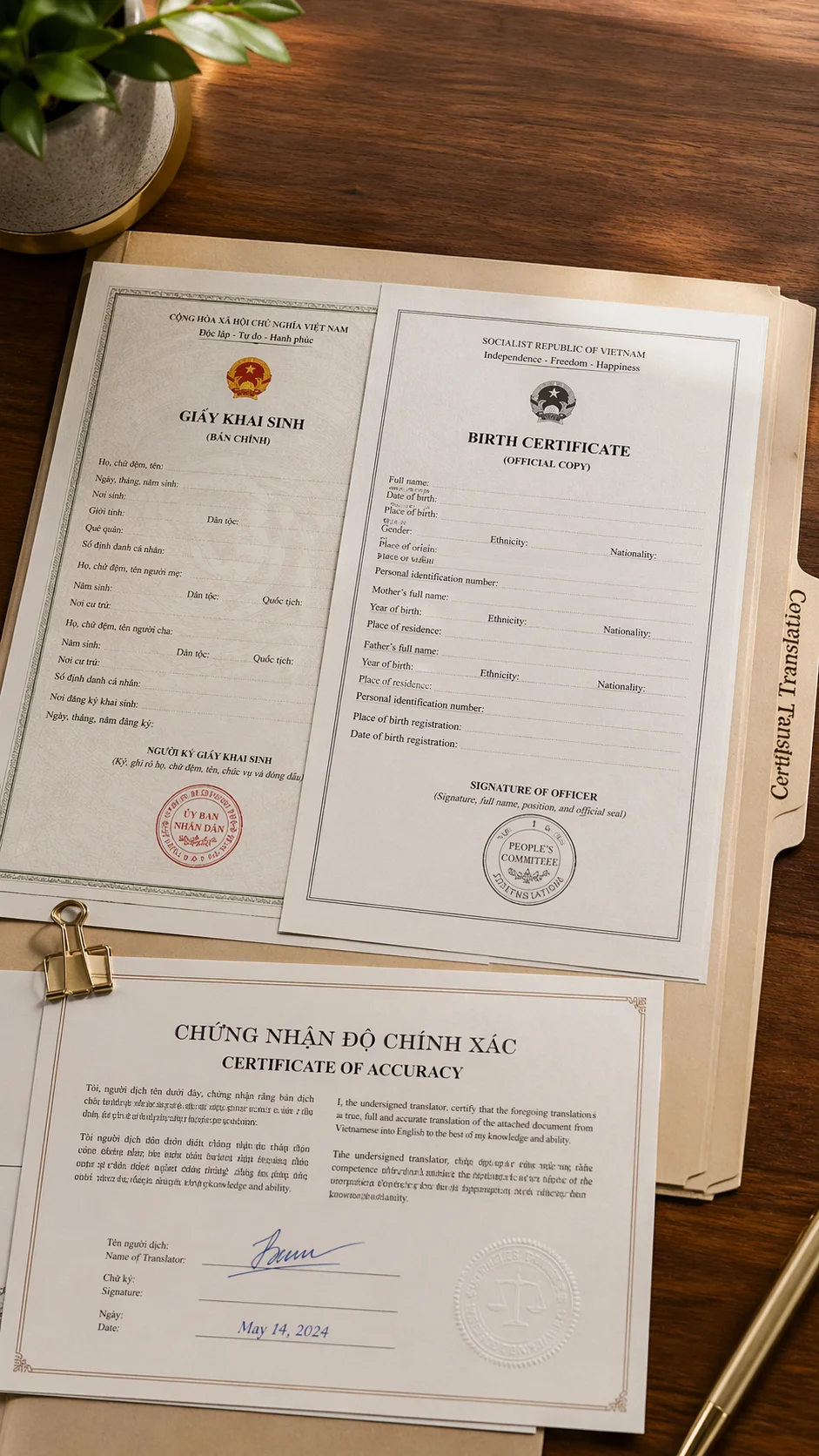
Certified Vietnamese translation is a complete translation of a Vietnamese-language document paired with a signed certificate of accuracy naming the translator, and Kaplan formats it for the hospital, court, or agency that will receive the document. Diacritics matter because Vietnamese uses Latin letters with tone and vowel marks that change the word entirely, so a stripped mark produces a different word rather than a missing accent. Kaplan verifies mark integrity in the delivery format, fixes the Vietnamese name convention once and holds it across a filing, translates patient material for comprehension rather than literal equivalence, and matches vocabulary to Southern usage where the reader is a United States community member.

Vietnamese Translation
Clinical & Patient-Facing Documents
Translation of discharge instructions, consent forms, medication guidance, and care plans for Vietnamese-speaking patients, which is the largest single share of real Vietnamese document demand. Patient material is translated for comprehension at the reading level of the person who has to act on it, not for literal equivalence with the English.
Vietnamese Translation
Civil Records & Personal Documents
Translation and certification of birth and marriage records, household documents, academic transcripts, and Vietnamese notarial certificates. Names are the recurring difficulty: Vietnamese order places the family name first and the middle element carries meaning, so the convention is fixed once and held across the whole filing.

Vietnamese Translation
Community, Benefits & Public Notices
Translation of benefit letters, program notices, tenancy documents, and community-facing material for the Vietnamese-speaking populations concentrated in Orange County, Houston, San Jose, Boston, and the Gulf Coast. Written to be acted on, because a notice a recipient cannot follow has not achieved what it was sent to do.

Vietnamese Translation
Commercial & Employment Documents
Translation of employment agreements, handbooks, safety instructions, and supplier correspondence for employers with Vietnamese-speaking workforces and for manufacturing and seafood supply chains trading with Vietnam. Safety and procedural text is rendered as instruction, because a worker reading a step needs a command.
Why Kaplan
Built for Vietnamese Document Accuracy
Diacritics Preserved and Verified
Vietnamese is written in Latin script with tone and vowel marks that change the word entirely. Stripped or mangled diacritics are the most common Vietnamese document failure, so delivered files are checked for mark integrity in the format you will actually use.
Name Convention Fixed Once
Family name first, and the middle element carries meaning rather than being a spare initial. The convention is settled at the start and held across every document in a filing, because two renderings of one name is a discrepancy a reviewer must resolve.
Patient Material Written to Be Acted On
Discharge instructions and consent forms are translated for comprehension and reading level. A consent form that is faithful to the English and above the patient's reading level has not achieved informed consent.
Regional Vocabulary Matched to the Reader
Northern and Southern vocabulary differ, and American Vietnamese communities are overwhelmingly Southern in origin. Community and patient material is matched to the reader rather than to a textbook standard.
Signed Certificate of Accuracy
Certified Vietnamese translations are delivered with a signed certificate naming the translator, and Kaplan formats it for the hospital, agency, court, or university that will receive the document.
Encoding That Survives Your Systems
Files are delivered in encodings that hold the diacritics through your intake forms and record systems, because a correct translation that arrives corrupted in a portal is still unusable.
Client Feedback
What Our Clients Say
"The tone marks survived our patient portal. Every previous vendor gave us files that arrived stripped and our staff had to retype them."
Thu-Ha L.
Patient Services Supervisor
"Names were rendered the same way on every document in the packet. That sounds small until a reviewer asks you why it changed."
Gregory P.
Immigration Paralegal
FAQs
Common Questions
Why do Vietnamese diacritics matter so much in a document?
+
Because they are not decoration. Vietnamese uses Latin letters with tone and vowel marks that change the word entirely, so a stripped mark does not produce an accented-looking word, it produces a different one. Mangled diacritics are the single most common failure in Vietnamese document work, usually introduced by a form or record system rather than by the translator, so we verify mark integrity in the format you will actually use.
What makes a Vietnamese translation certified?
+
A complete translation accompanied by a signed certificate of accuracy from the translator. Hospitals, courts, USCIS, universities, and agencies rely on that certificate before accepting a Vietnamese-language document. The certificate names the translator and attests to completeness, which is why machine output cannot substitute for it.
How are Vietnamese names handled across a filing?
+
The convention is settled once and held throughout. Vietnamese order places the family name first, and the middle element carries meaning rather than functioning as a spare initial, so it is not dropped or reduced. Where a person already has an established spelling in use in the United States, we adopt theirs rather than imposing a system.
Does Northern or Southern Vietnamese matter for documents?
+
Less than for speech, but it matters for anything a person reads and acts on. Vocabulary differs between Northern and Southern usage, and Vietnamese communities in the United States are overwhelmingly Southern in origin. Patient and community material is matched to the reader. For formal legal and civil documents the standard written register is used.
Can you translate medical records and patient instructions?
+
Yes, and it is the largest share of the Vietnamese work we see. Vietnamese-specific clinical and patient-facing material is handled here. For the discipline itself, including clinical research, HIPAA handling, and multi-specialty records, see certified medical translation, which sets out how clinical documents are assigned and reviewed.
Do you cover Vietnamese-speaking communities outside California?
+
Yes. Work is delivered nationwide, and the concentrations we see most are Orange County, Houston, San Jose, Boston, and the Gulf Coast. Document translation is not geographically limited, so a Massachusetts or Texas filing is handled the same way as a California one. Geography matters for interpreters, not for documents.
What if the documents are going to USCIS?
+
Then certification format is the part that matters. Documents going to USCIS or a consulate are handled by our immigration document translation service, which formats certification to those filing requirements. A document certified for a hospital can still be returned by USCIS.
Do you also provide Vietnamese interpreters?
+
Yes, and that is the spoken service. Documents are translation, an appointment or deposition is interpreting. See Vietnamese interpreters for the spoken side and Vietnamese language background for how dialect behaves on a record.
How do I request a certified Vietnamese translation quote?
+
Send the documents, the target languages, and the body that will receive them through our online form or by phone at (833) 547-7770. We confirm certification format, delivery encoding, and turnaround, and provide a fixed quote before work begins.
Related Vietnamese Language Services
Documents and appointments are different jobs. An interpreter who has read the translated record arrives already familiar with the case, which shortens the appointment and reduces repetition for the patient.
Request a Certified Vietnamese Translation Quote
Send your documents and tell us who receives them. We confirm certification format, delivery encoding, and turnaround before work begins.