
Taking a Deposition in Texas: The Interpreter Credential Does Not Travel
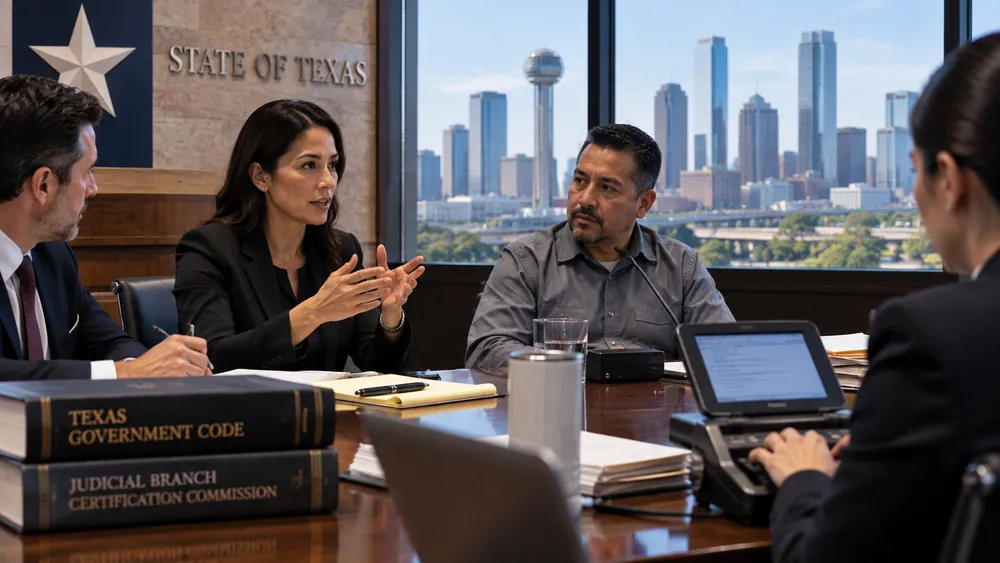
A firm with a California matter notices a deposition in Dallas or Houston, books the interpreter the same way it always does, and assumes the credential means the same thing on the other side of the state line. It does not. Interpreter credentialing is state by state, and Texas licenses on a tier system that California does not use.
Two Separate Licensing Systems
California certifies court interpreters through the Judicial Council. Texas licenses them through the Judicial Branch Certification Commission under Government Code Chapter 157.
Neither confers the other. A California certified court interpreter holds no Texas license by virtue of the California credential, and the reverse is equally true. Federal certification is a third thing again, governed by its own statute and its own exam, and it does not substitute for either state’s requirement.
Basic and Master Are Not Interchangeable
Texas issues licensed court interpreters at two designations, basic and master.
A master designation permits the interpreter to work in all courts in the state, including justice and municipal courts. A basic designation is considerably narrower: it permits interpreting in justice and municipal courts that are not municipal courts of record, and it excludes proceedings where the judge is acting as magistrate.
The practical consequence is that “licensed court interpreter” on a Texas resume is not a complete answer. The follow-up question is which designation, and whether it reaches the forum your matter is in. A basic license is a real credential that does not cover a district court case.
A Deposition Is Not Governed by Either List
A deposition is not a court proceeding. No judge is supplying an interpreter, no state licensing tier is being enforced at the door, and nothing automatically disqualifies an interpreter who lacks a Texas license from working a deposition in Texas.
Because no statute sets the floor, the floor is whatever the parties agree to and whatever the record will bear later. If the testimony from that deposition is read at trial, offered on summary judgment, or used to impeach, the interpretation becomes evidence, and the question of who rendered it gets asked by the side that does not like the answer. The exposure moves from a rule to a record.
What Protects the Transcript
Credential first, stated on the record. Whether it is a Texas master license, a federal certification, or a California certification held by an interpreter traveling in, name it in the appearance so the transcript carries it. An objection raised eight months later is much weaker against a record that already answered it.
Language and variety, confirmed before the date. Spanish is the most-credentialed language in both states and still the one most often mismatched by region.
One interpreter across related proceedings where possible. Two interpreters rendering the same terminology two ways across a deposition and a hearing is an inconsistency the other side will use, and it has nothing to do with the witness.
Team coverage on anything long. Accuracy degrades with fatigue before anyone in the room notices, which is why extended testimony is staffed with two interpreters who trade off.
Booking Across State Lines
Local supply is what usually decides the date.
Texas metros carry genuine depth in Spanish and thin coverage in most other languages, which is the same pattern as California and every other state. For an interpreter in Dallas or a Houston deposition, Spanish can usually be confirmed on reasonable notice. Mandarin, Vietnamese, Korean, Arabic and anything rarer are a sourcing exercise, and the answer to “can we get someone by Thursday” is often no.
That is worth knowing three weeks out rather than three days out.
Kaplan Interpreting Services sources court certified, licensed and federally certified interpreters for depositions, hearings and arbitrations nationwide, matched to the forum and the state whose rules apply. Contact us with the state, the county, the proceeding type, the language and variety, and the date, and we will confirm what coverage exists before the notice goes out.
Not legal advice. Licensing schemes and deposition practice vary by state. Verify the current requirements in the forum state.

CEO & Founder
Born in Dallas, Texas, Alexandra grew up surrounded by Spanish, English, Arabic, and Italian. After moving to Venezuela, Spanish became her primary language. She holds a Master's in Healthcare Administration from Washington University in St. Louis and is a California court certified and medical interpreter.
She founded Kaplan Interpreting Services after seeing an industry that treated interpreters as interchangeable and clients as ticket numbers. She built a protocol-driven operation where every interpreter is hand-selected and credentialed for the specific setting, every client has a dedicated point of contact, and risk management is built into every assignment.
Her career reached a historic milestone when she interpreted the conversation between President-elect Biden and Pope Francis. That assignment, along with engagements for Nike and the Summit of the Americas, set the standard for every client engagement that followed.
"The same protocols that protected that historic conversation now protect every assignment we handle."