
When Spanish Is the Wrong Interpreter: Indigenous Language Rights and Best Practice in U.S. Courts
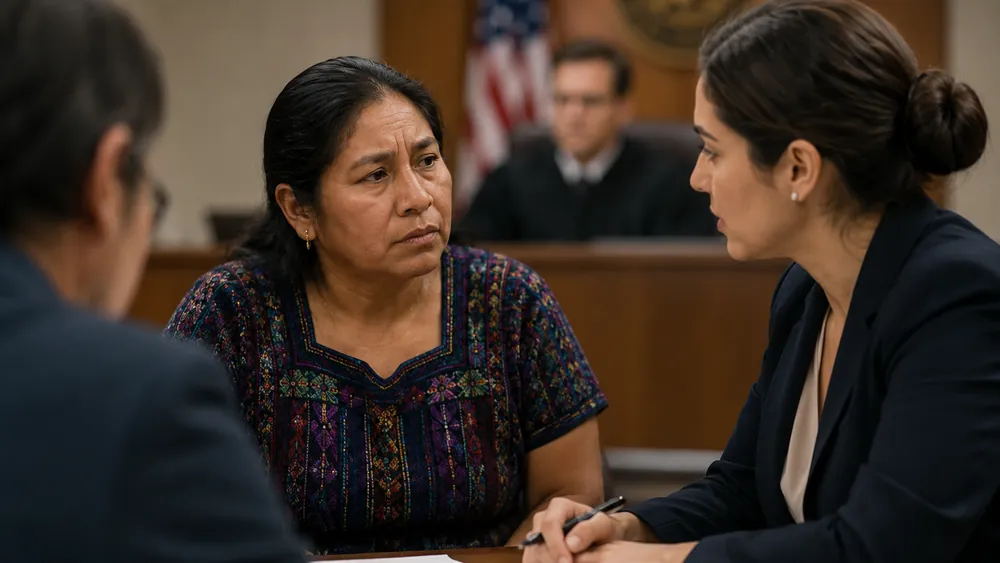
The assumption that a client from Guatemala or southern Mexico speaks Spanish as their primary language is wrong often enough to have produced wrongful convictions, overturned appeals, and federal court findings of reckless conduct. It is also one of the most common assumptions made at criminal intake.
How Big This Population Is
Roughly one in five people in immigration detention may be an Indigenous-language speaker. Indigenous languages account for an estimated 10 to 44 percent of new arrivals at the U.S.-Mexico border, according to linguist Carol Rose Little of the University of Oklahoma, writing in June 2026. These are not speakers of regional Spanish dialects. They are speakers of Mam, Mixteco, Triqui, Zapoteco, and dozens of other Indigenous languages of Mesoamerica that are unrelated to Spanish and in many cases unrelated to each other.
California’s own court interpreter workforce data shows how strained the supply of interpreters already is. The number of interpretations delivered by provisionally qualified interpreters, meaning no credentialed interpreter was available for that language, tells the story:
- Mixteco de Guerrero: 10 interpretations in FY 2020-21, rising to 856 in FY 2023-24
- Mixteco: 550 rising to 1,331
- Triqui: 515 rising to 737
The Judicial Council found Indigenous languages “consistently described as the most difficult to cover,” with courts regularly relying on universities and informal networks to locate interpreters at all. The shortage is real. It is also not a reason to proceed with an interpreter the client cannot fully understand.
What Has Happened When the Wrong Interpreter Was Used
The cases are documented and they have consequences.
In the 1980s, a Mixtec speaker in Oregon was tried for murder through a Spanish interpreter he barely understood. He was convicted and served four years before the conviction was overturned on the grounds that he had not been able to meaningfully participate in his own defense.
In 2022, a Northern Tepehuan speaker in Texas was charged with drug possession. His own attorney and a certified Spanish interpreter both testified at a pre-trial hearing that he could not adequately understand or communicate in Spanish. The court proceeded with a Spanish interpreter, found him guilty, and sentenced him to 24 months. The conviction was appealed to the Fifth Circuit, which affirmed, but the record of a proceeding in which both defense counsel and a professional interpreter testified the language wasn’t working is precisely the kind of record that invites appeal and creates exposure for everyone involved.
In October 2025, two Mam-speaking Guatemalan farmworkers were detained by ICE in Oregon and signed paperwork they did not understand. A federal judge later found the agents’ conduct reckless and erroneous and ordered their release. The paperwork they signed without comprehension was the problem.
In Martinez v. State, decided by the Alaska Court of Appeals in 2023, a Triqui-speaking defendant from Mexico proceeded through trial with Spanish interpreters and his bilingual pastor present during breaks. The court affirmed the conviction, finding the arrangement did not automatically render his waiver of the right to testify involuntary. That outcome may be legally defensible. It is not best practice.
Why the Misclassification Keeps Happening
A client who speaks working Spanish as a second or third language will often answer yes when asked if they speak Spanish. That answer is true and insufficient. They may be able to order food, follow simple instructions, and answer a direct question, and still be unable to follow cross-examination, understand the legal concepts being explained to them, or give complete and accurate testimony in a second language they learned informally.
The misclassification also happens because saying no carries risk. Many Indigenous-language speakers have spent their lives in settings where speaking Spanish is expected and speaking an Indigenous language is stigmatized. In a courtroom with immigration exposure and law enforcement present, the incentive to nod along is real. The client is not being deceptive. They are being careful. The result is a language identification that feels resolved and is not.
There is a second layer the intake question rarely catches. Many Indigenous languages of Mexico and Guatemala are not related to Spanish and are not mutually intelligible with each other. Mam and Mixteco are unrelated languages. Mixteco itself varies enough by region that a Mixteco Alto interpreter may not be able to serve a Mixteco de Guerrero speaker. Booking a Mixteco interpreter without confirming the variant is the same mistake made one level down.
What Counsel Should Ask at Intake
Where is the client from, specifically? Region and municipality matter more than country. Guatemala’s western highlands and the Mexican states of Oaxaca, Guerrero, and Puebla are where these languages concentrate.
What language did they speak at home growing up? This gets a truer answer than “do you speak Spanish.”
What language do they count, pray, or argue in? People revert to a first language for numbers, emotion, and precision: exactly the parts of testimony that carry the most weight.
How did they learn Spanish, and how far did they get in school? Informal Spanish acquired at work is not the same as Spanish adequate for cross-examination on criminal charges.
Which variant? For Mixteco especially, the region determines whether a given interpreter can actually serve the client.
Ask again after rapport exists. The first answer is often the socially safe one. The accurate answer frequently comes later.
Raising the language question early buys the one thing that actually helps: time. Sourcing a Mam or Triqui interpreter is not a next-day exercise. A continuance requested three weeks out is a scheduling matter. The same request the morning of the hearing is a crisis.
The Standard Worth Holding
The Federal Court Interpreters Act requires certified or otherwise qualified interpreters for defendants who speak “only or primarily” a language other than English. Courts applying that standard have found ways to proceed when a defendant can manage in a second language well enough that the proceedings are not, in the legal phrase, “fundamentally unfair.” That threshold has been met and affirmed on appeal in cases where everyone in the room knew the arrangement was imperfect.
Imperfect and defensible is not the standard worth aiming for. A defendant who is interpreted in their primary language, the language they actually think in, testify in, and understand their rights through, is a defendant whose record is genuinely sound, not just legally passable. That is the standard that protects the client, protects the record, and protects the attorney responsible for both.
Kaplan Interpreting Services sources court certified and professionally qualified interpreters for Indigenous languages of Mexico and Guatemala, including Mam, Mixteco by variant, Triqui, and Zapoteco, for criminal defense, immigration proceedings, and civil matters nationwide. Contact us with the client’s region of origin, the suspected language and variant, the proceeding type, and the date, and we will confirm what coverage exists before it becomes a scheduling emergency.
Not legal advice. Standards vary by jurisdiction.

CEO & Founder
Born in Dallas, Texas, Alexandra grew up surrounded by Spanish, English, Arabic, and Italian. After moving to Venezuela, Spanish became her primary language. She holds a Master's in Healthcare Administration from Washington University in St. Louis and is a California court certified and medical interpreter.
She founded Kaplan Interpreting Services after seeing an industry that treated interpreters as interchangeable and clients as ticket numbers. She built a protocol-driven operation where every interpreter is hand-selected and credentialed for the specific setting, every client has a dedicated point of contact, and risk management is built into every assignment.
Her career reached a historic milestone when she interpreted the conversation between President-elect Biden and Pope Francis. That assignment, along with engagements for Nike and the Summit of the Americas, set the standard for every client engagement that followed.
"The same protocols that protected that historic conversation now protect every assignment we handle."