
Arbitration Interpreters: What Counsel Should Settle Before the First Hearing Day
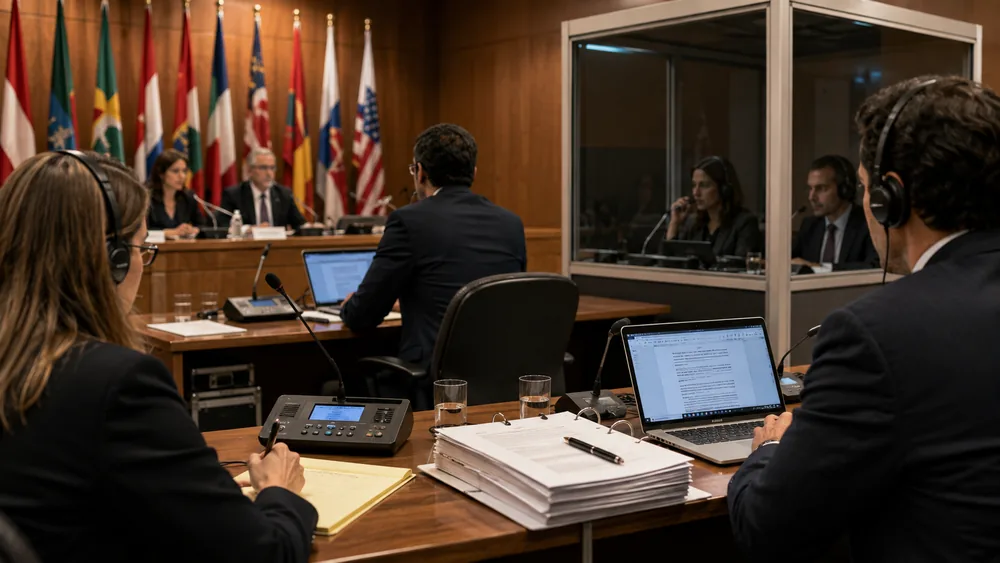
In court, the tribunal often supplies the interpreter. In arbitration, nobody does. The parties arrange it, the parties pay for it, and if the interpretation goes wrong there’s no judge who selected the interpreter to share responsibility for it. That’s a meaningful shift in exposure, and it lands on counsel. Here’s what to settle, in Q&A form, before the first hearing day.
Who provides the interpreter in an arbitration?
The parties do, and the arbitration rules generally leave the arrangement to them.
Institutional rulesets from the American Arbitration Association, JAMS, and the ICDR give the tribunal broad discretion over the conduct of the hearing, including language and interpretation, but they don’t staff an interpreter the way a courthouse does. In practice the tribunal will expect the parties to raise the issue and propose an arrangement, and will resolve it if the parties disagree.
That means the default is not “someone will handle it.” The default is that nobody handles it until counsel does.
Why does this matter more in arbitration than in court?
Because the path to undo a bad outcome is much narrower.
Under the Federal Arbitration Act, a court may vacate an award only on the limited grounds in 9 U.S.C. § 10, which cover things like corruption, evident partiality, and refusal to hear pertinent evidence. There’s no general appeal for factual error. A trial court’s evidentiary mistake can be reviewed on appeal. An arbitral award built on garbled testimony usually cannot be, unless the facts happen to fit one of those narrow grounds. Whether a given interpretation failure could ever support vacatur is a fact-specific question for your own analysis, and the honest planning assumption is that it won’t.
So the protection isn’t the back end. It’s the front end.
Should the interpreter arrangement go in the procedural order?
Yes, and this is the single highest-value step available.
Most tribunals issue a first procedural order covering scheduling, exhibits, and hearing logistics. Interpretation belongs there, and it costs nothing to add. Useful items to include: the language and dialect, whether interpretation will be simultaneous or consecutive, whether a check interpreter is permitted, how objections to a rendering will be raised and recorded, and who bears the cost.
Settling it in writing early converts a potential mid-hearing dispute into an administrative detail. Leaving it unaddressed means the first time anyone discusses it is when a witness is already on the stand.
Simultaneous or consecutive?
Consecutive for testimony, simultaneous for everything else, is the usual working answer.
Consecutive interpretation, where the interpreter renders after each question and answer, produces a cleaner record because each rendering is discrete and can be challenged on the spot. It roughly doubles the time for that testimony, which matters when hearing days are expensive and finite.
Simultaneous interpretation, delivered through equipment while proceedings continue, is the right mode for a party who needs to follow argument, procedural discussion, and other witnesses’ testimony without stopping the hearing. Many arbitrations use both: simultaneous for the party to follow along, consecutive on the record when that party’s witness testifies.
Decide which applies to which segment before day one, because the equipment and the interpreter count both depend on the answer.
How many interpreters does a hearing day need?
For sustained simultaneous work, two. For intermittent consecutive testimony, often one.
Simultaneous interpretation is cognitively punishing and accuracy degrades measurably after roughly thirty minutes of continuous work. The professional standard for sustained simultaneous is a team of two rotating. A single interpreter booked to cover a full day of simultaneous is a false economy that shows up as errors in the afternoon.
Consecutive testimony that runs intermittently across a day can often be handled by one interpreter with normal breaks. The distinguishing question is total minutes of active interpreting, not total hours on site.
What if the other side objects to a rendering mid-hearing?
Then you want a procedure already agreed, and the original-language audio preserved.
Disputes over a specific rendering are normal and not a crisis. What turns them into a problem is having no agreed way to handle them. A workable approach, ideally set in the procedural order: the objecting party states the disputed word or phrase on the record, the interpreter restates the rendering and may explain the choice, and the tribunal rules or notes the disagreement for later resolution.
Preserving the original-language audio is what makes any later resolution possible. If only the English rendering is captured, a disputed phrase can’t be re-examined by anyone.
What if a party’s own bilingual employee offers to interpret?
Decline it. This is the most expensive shortcut available in an arbitration.
The offer usually comes from a good place. A bilingual manager knows the business, knows the terminology, and costs nothing. But that person has a stake in the outcome, which is exactly what disqualifies them. Opposing counsel gets to ask on the record who interpreted the testimony, what their relationship to the party is, and whether they have an interest in the result. Every answer damages the testimony they rendered.
There’s a narrower version of the same problem with a bilingual attorney on the team stepping in. It creates a witness-adjacent role for someone who is supposed to be advocating, and it puts counsel in the position of having their own rendering questioned.
The interpreter should be a neutral professional with no relationship to either party. That neutrality is most of what makes the rendering worth anything.
Can a party bring its own check interpreter?
Usually yes, if it’s raised in advance and the role is defined.
A check interpreter monitors the record interpreter and flags concerns. Tribunals commonly permit it. The problems arise when a check interpreter shows up unannounced, or starts interjecting freely, or is a party representative rather than a neutral professional.
Define the role in advance: who they are, what credential they hold, when they may speak, and to whom they raise a concern. A check interpreter operating under agreed rules is a safeguard. One operating without them is a disruption.
What credential should an arbitration interpreter have?
Court certification in the language pair, plus real experience in the proceeding type.
Arbitration runs on courtroom register with commercial and technical subject matter layered on top. A construction defect arbitration, a securities dispute, and a cross-border distribution disagreement each carry their own terminology. Court certification establishes the interpreting competency. Subject-matter experience is what keeps a technical term from being rendered by feel.
For arbitration and other high-stakes commercial proceedings, the confirmation should name the interpreter, the certification, the language and dialect, and prior experience in comparable matters. That’s the same verification discipline that applies to any proceeding where the record has consequences.
What should counsel settle before day one?
- Raise interpretation in the first procedural order. Language, dialect, mode, cost allocation, objection procedure.
- Decide mode per segment. Consecutive for testimony, simultaneous for following proceedings.
- Book two interpreters for sustained simultaneous. One for intermittent consecutive.
- Confirm equipment and the room. Booth or portable equipment, receivers, a tested audio feed.
- Preserve original-language audio. Without it, no disputed rendering can be revisited.
- Define the check-interpreter role in advance, if either side wants one.
- Verify credential and subject-matter fit, named on the confirmation.
- Send materials to the interpreter early. Exhibit lists, technical glossaries, party and witness names. Preparation is where accuracy is built.
Bottom line
Arbitration trades procedural formality for speed and finality, and finality cuts both ways. The record is what the tribunal heard, and if a party spoke through an interpreter, the interpretation is the testimony. There’s no realistic mechanism to fix that afterward.
The work that protects it is unglamorous and entirely front-loaded: a paragraph in the procedural order, a mode decision, the right number of credentialed interpreters, preserved audio, and materials sent in advance. All of it happens before anyone sits down.
Kaplan Interpreting Services provides court-certified interpreters for commercial and international arbitration across California and nationally, matched by language, dialect, and subject matter, with simultaneous equipment and team coverage arranged for sustained hearing days. Related reading: certified document translation for arbitral exhibits and what belongs on a certificate of accuracy.
Contact us with the language, hearing dates, expected testimony volume, and subject matter, and we’ll confirm the interpreter team and equipment before your first procedural order goes out.
Not legal advice. Unauthorized practice of law rules vary by state.

CEO & Founder
Born in Dallas, Texas, Alexandra grew up surrounded by Spanish, English, Arabic, and Italian. After moving to Venezuela, Spanish became her primary language. She holds a Master's in Healthcare Administration from Washington University in St. Louis and is a California court certified and medical interpreter.
She founded Kaplan Interpreting Services after seeing an industry that treated interpreters as interchangeable and clients as ticket numbers. She built a protocol-driven operation where every interpreter is hand-selected and credentialed for the specific setting, every client has a dedicated point of contact, and risk management is built into every assignment.
Her career reached a historic milestone when she interpreted the conversation between President-elect Biden and Pope Francis. That assignment, along with engagements for Nike and the Summit of the Americas, set the standard for every client engagement that followed.
"The same protocols that protected that historic conversation now protect every assignment we handle."