
Only 1,400 Federally Certified Court Interpreters Nationwide: What August's Exam Means for Your Federal Case
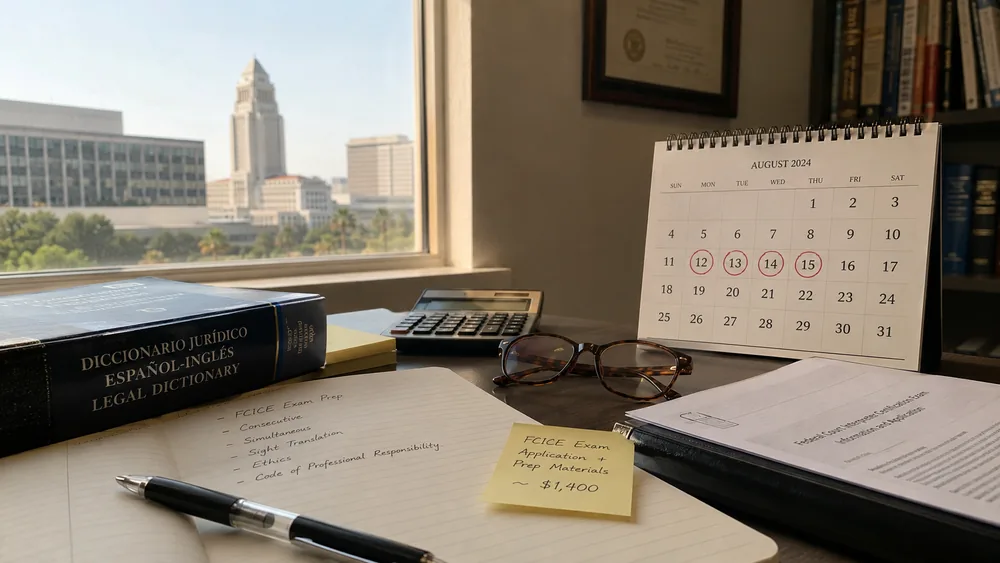
Fewer than 1,400 federally certified court interpreters are active in the entire country, according to the U.S. Courts Federal Court Interpreter Certification Examination program. That is the pool an attorney with a federal case is drawing from every time they need Spanish-English on the record. The pool is about to have its one and only chance this year to grow, and the math on how much it can grow is small.
The FCICE oral phase runs August 3 through 17, 2026. Registration is open now and closes July 31, or sooner if the seat cap fills. That cap is 400 candidates. The historical oral-phase pass rate is 7 to 10 percent, per the Prometric examinee handbook. If the exam fills every seat and lands at the top of the historical range, that is roughly 40 new federally certified interpreters. If it lands at the bottom, closer to 28.
That is the entire annual net add, before attrition, before retirements, before interpreters who let credentials lapse. And the number applies only to Spanish. Federal certification for Navajo and Haitian Creole existed once but is no longer administered, which means every other language relies on a different credential tier the court has to accept on the record.
Why this matters at intake
Federal district court, EOIR immigration proceedings, and federal arbitration all require a specific credential posture on the record. The credential is not interchangeable with state certification. When an interpreter is not federally certified, federal courts use two lower classifications: professionally qualified, which requires documented credentials such as a passed State Department conference interpreter test or a recognized professional membership, and language skilled, which requires the interpreter to demonstrate ability to the court’s satisfaction. Neither is the same thing as federal certification, and the distinction has to appear in the record if the testimony is ever challenged on appeal.
Most attorneys do not run into this until a deadline is on top of them. A federal deposition gets set on short notice, someone books a Spanish interpreter through the usual channel, and the credential question does not surface until opposing counsel raises it during the record or during a motion to strike after the fact. By then, the choice of who was in the chair is not something you can change.
The practical questions to ask
A short intake list keeps the credential question in front of you before it becomes a problem:
- Is this a federal proceeding? Federal district court, EOIR immigration court, federal arbitration, federal deposition, federal grand jury. If yes, the credential threshold is different.
- Is the language Spanish? If yes, ask whether the interpreter is federally certified. If not, ask how their qualifications will be documented on the record.
- Is the language something other than Spanish? No federal certification exists. Ask whether the interpreter meets the professionally qualified or language skilled tier and how that will be reflected in the record.
- How is the interpreter being sourced? A professional interpretation firm verifies credentials before every assignment. A last-minute booking from a general staffing agency does not.
- What is the fallback? If the assigned interpreter is unavailable, who is the next-up name, and are their credentials at the same tier?
Every one of these questions takes thirty seconds to ask and can save weeks of appellate briefing.
What the exam window changes for the rest of 2026
The August oral phase is the only federal certification exam this year. After August 17, the pool of federally certified Spanish interpreters is what it is until the next cycle. If a case set for the fall is going to need federally certified coverage, the interpreter who takes the chair is almost certainly already on the current list. Waiting to source is not going to expand the option set. It is going to narrow it, because everyone else with a federal calendar is drawing from the same pool at the same time.
There are two useful moves right now. First, if there is a federal proceeding on the calendar for August through December, confirm the interpreter before the exam window closes so scheduling is not competing with the top of the demand curve. Second, if a matter involves a language with no federal certification track, get the professionally qualified or language skilled documentation drafted now, not the morning of the hearing.
The record does not forgive interpretation gaps
An interpretation record built on the wrong credential is a record that can be challenged. Opposing counsel can raise it. An appellate court can look at it. A witness can dispute a rendered translation and have a plausible basis to do so if the credential tier was not documented. The same exposure applies to written exhibits, where certified legal document translation has to carry a named translator and a certificate of accuracy. None of that shows up in the estimate for the deposition. It shows up later, when the case is being tested by people who were not in the room.
The federal interpreter pool is small, and it is growing by a very small number this year. Sourcing early and documenting credentials cleanly is what keeps the interpreter question from becoming the record question.
Talk to us if you have a federal matter coming up this fall and want to lock in the credential tier before the schedule gets tight.

CEO & Founder
Born in Dallas, Texas, Alexandra grew up surrounded by Spanish, English, Arabic, and Italian. After moving to Venezuela, Spanish became her primary language. She holds a Master's in Healthcare Administration from Washington University in St. Louis and is a California court certified and medical interpreter.
She founded Kaplan Interpreting Services after seeing an industry that treated interpreters as interchangeable and clients as ticket numbers. She built a protocol-driven operation where every interpreter is hand-selected and credentialed for the specific setting, every client has a dedicated point of contact, and risk management is built into every assignment.
Her career reached a historic milestone when she interpreted the conversation between President-elect Biden and Pope Francis. That assignment, along with engagements for Nike and the Summit of the Americas, set the standard for every client engagement that followed.
"The same protocols that protected that historic conversation now protect every assignment we handle."