
California WCAB Rulings Confirm: Interpreters at C&R Signings Can Recover Market Rate
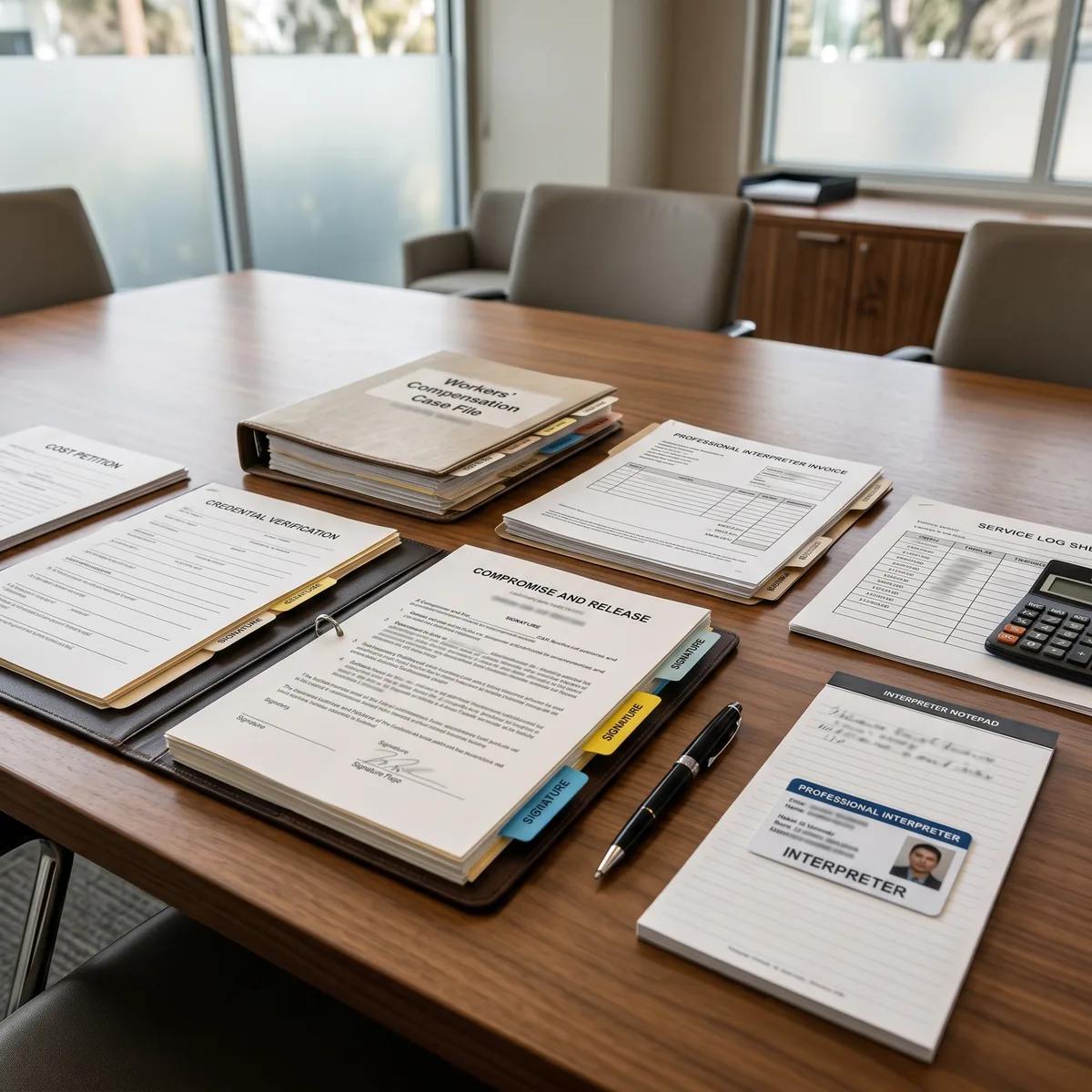
Two 2026 WCAB panel decisions have quietly settled a question that has frustrated interpreting agencies, defense counsel, and carriers for years. When a qualified interpreter renders a Compromise and Release agreement to a non-English-speaking injured worker, the agency is not limited to the statutory fee schedule. With proper documentation, market-rate recovery is on the table.
This matters because C&R signings are not routine paperwork. They are the moment an injured worker permanently settles their claim, often for a lump sum that closes out future medical benefits. If that worker does not speak English, the interpreter is not a convenience. They are the proceeding. The Board’s recent decisions reflect that reality.
What the Cases Actually Said
In Hernandez (ADJ10371658), an interpreting agency submitted a $270 invoice for services rendered at a C&R signing for a Spanish-speaking injured worker. The defendant contested it. The WCAB sustained the cost petition. The agency was entitled to be paid, and the challenge failed.
In Verdeja (ADJ16188766), the facts were slightly different. A workers’ compensation judge found the interpreter’s services reasonable and necessary but capped payment at the AD Rule 9795.3(b)(2) statutory rate. The interpreting agency sought reconsideration, arguing that market rate, not the statutory floor, was the appropriate measure. The Board granted reconsideration, opening the door to above-schedule recovery.
Read together, the decisions establish a clear path: reasonable, necessary, properly documented in-person interpreter work at a C&R signing is not automatically capped at the statutory minimum. The statutory rate is a floor, not a ceiling, when the documentation supports more.
What Determines Whether You Recover Market Rate
The Board’s decisions turn on documentation, not just credentials. Showing up with a qualified interpreter is necessary but not sufficient. Agencies that are positioned to recover above the statutory rate are the ones that can demonstrate exactly what was done, when, and for whom.
That means invoices should show time in, time out, the language pair, the proceeding type, and the parties present. It also means the interpreter’s credentials and workers’ comp experience should be verifiable, not assumed. And it means the cost petition itself needs to be filed correctly. Reconsideration is the procedural path when a WCJ caps recovery at the statutory rate and the record supports more.
Vague invoices invite challenge regardless of the quality of the underlying work. A clean, specific invoice from a credentialed agency is now significantly harder to defeat at the WCAB level.
What This Means for Each Party
Defense counsel: Challenges to interpreter cost petitions based solely on the fee schedule are harder to sustain when the documentation is solid. Before contesting a properly documented invoice, consider whether the cost of the dispute exceeds what you stand to save.
Applicant attorneys: The Board reaffirmed that interpreter services at a C&R signing are reasonable and necessary, not optional. An injured worker who signs a settlement agreement without a qualified interpreter raises due process concerns the Board has cited before. The interpreter’s fee is not where you want to cut corners on a permanent settlement.
Carriers and TPAs: Market-rate cost petitions are becoming more common, and more of them are surviving reconsideration. Build that into your settlement cost projections and take a look at your interpreter procurement standards before the next disputed invoice lands on your desk.
The Bottom Line
The question is no longer whether you had an interpreter at the C&R signing. It’s whether you had a qualified, properly documented interpreter who can demonstrate the work to the Board. Those are two different procurement decisions, and as of 2026, the WCAB is treating them that way.
For Los Angeles WCAB venues, Orange County, and Inland Empire workers’ compensation work, the procurement standard now starts at vendor onboarding. Contact us with the date, language, dialect, venue, and proceeding type. We will confirm availability and provide a quote.

CEO & Founder
Born in Dallas, Texas, Alexandra grew up surrounded by Spanish, English, Arabic, and Italian. After moving to Venezuela, Spanish became her primary language. She holds a Master's in Healthcare Administration from Washington University in St. Louis and is a California court certified and medical interpreter.
She founded Kaplan Interpreting Services after seeing an industry that treated interpreters as interchangeable and clients as ticket numbers. She built a protocol-driven operation where every interpreter is hand-selected and credentialed for the specific setting, every client has a dedicated point of contact, and risk management is built into every assignment.
Her career reached a historic milestone when she interpreted the conversation between President-elect Biden and Pope Francis. That assignment, along with engagements for Nike and the Summit of the Americas, set the standard for every client engagement that followed.
"The same protocols that protected that historic conversation now protect every assignment we handle."