
What Law Firms Are Changing in Interpreter Vetting Since the One Call Litigation
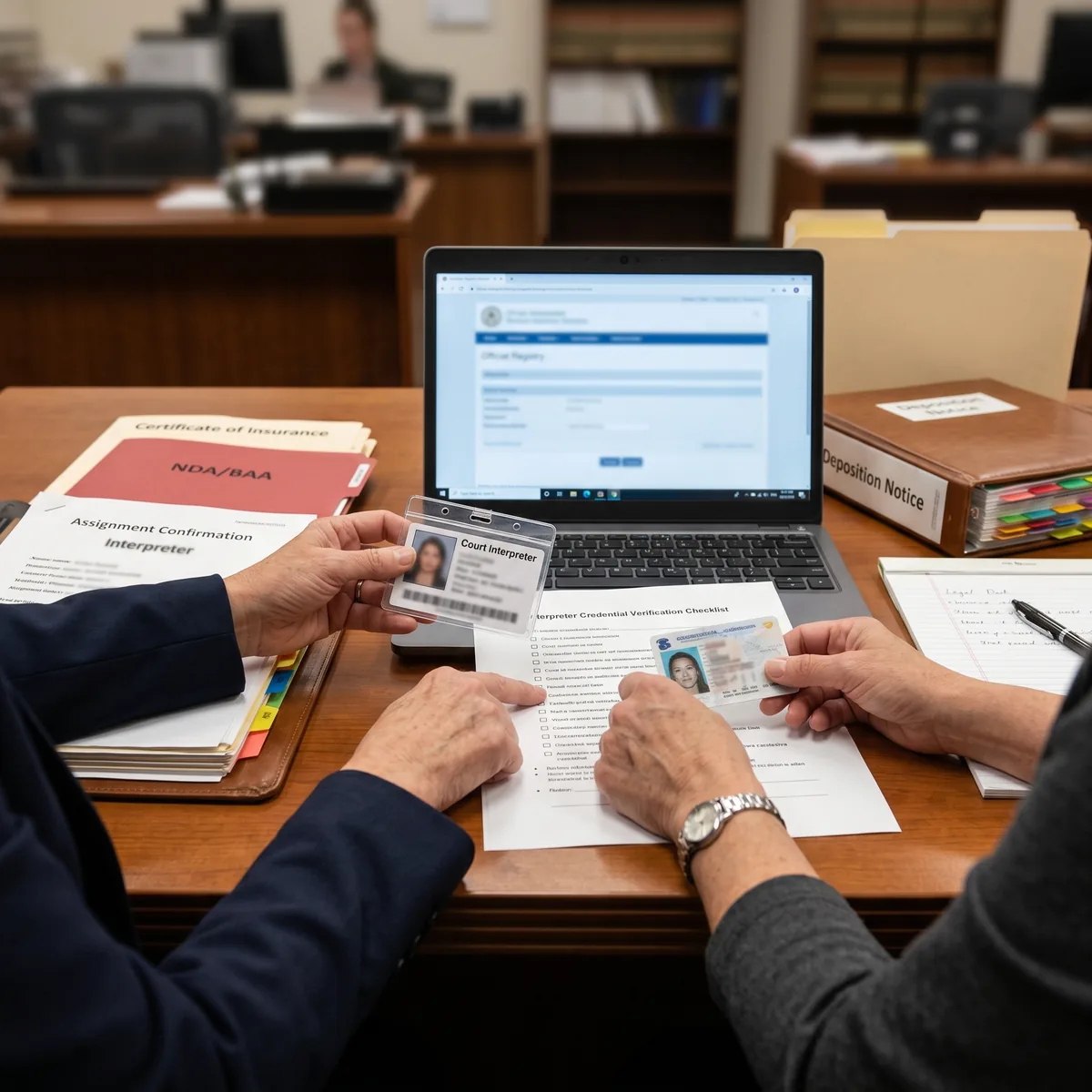
A litigation paralegal opens an email from the firm’s managing partner: “What is our vetting process for interpreters?” Nine months ago, most firms did not have a formal answer. Leading firms do now, and they have put it in writing.
The lawsuit against One Call Corporation alleges that the company knowingly sent uncredentialed employees to workers’ compensation depositions while presenting them as certified court interpreters, in some cases using stolen credential numbers and falsified identification badges. Courts are still working through the claims. But the case has already shifted how firms approach interpreter procurement, and here is what that looks like.
Credential Verification Moved to Vendor Onboarding
Elite firms are no longer waiting until an assignment is confirmed to verify interpreter credentials. Verification happens before the agency is added to the approved vendor list, so credentials are documented and on file before any work begins. The credential number, credentialing body, expiration date, and languages covered go into the vendor file at onboarding, which means every subsequent assignment starts from a verified foundation.
”Certified” Is No Longer a Sufficient Answer
Accepting “all our interpreters are certified” used to be standard practice. Top firms now want to know which credential, whether California Judicial Council, federal FCICE, or a state-specific exam, and the specific credential number for the court interpreter being assigned. The interpretation agencies these firms want to work with provide this as a matter of course, without hesitation. When an agency hedges or speaks in generalities, it gets removed from the approved vendor list.
NDAs and BAAs Are Signed at the Agency Level, Before Any Work Begins
Non-disclosure agreements and Business Associate Agreements used to get signed close to each individual assignment, sometimes the morning of. The cleaner approach is to execute both with the agency as an entity when it is first brought on as a vendor. The agreements cover the relationship rather than a single job, so the paperwork is done once and the protection is in place for every assignment that follows. For matters involving HIPAA-covered information, an unsigned BAA is a procurement blocker at onboarding, not a follow-up item.
Insurance Certificates Are Now Part of the File
Elite firms are requesting a current certificate of insurance from interpretation agencies, including professional liability coverage, as part of vendor onboarding. Professionally run interpreter services have this ready immediately. The ones that cannot produce it quickly are raising a broader question about how their operations are managed.
The Named Interpreter Is on the Confirmation
Confirmations reading “interpreter TBD” or “to be assigned” are no longer acceptable to firms running tight intake processes. The named court interpreter is expected on the confirmation document before the proceeding. That name is what allows the firm to cross-check the credential against the registry, request a CV if needed, and prepare a witness or client for a specific person in the room. Professional in-person interpreter services that operate on a vetted roster can provide this. Marketplace platforms that dispatch whoever is available generally cannot.
Credentials Are Re-Verified on an Annual Cycle
Credential verification used to be a one-time step. Leading firms now run an annual re-verification cycle, checking each interpreter’s credential against the credentialing body’s registry on a rolling basis. An expired credential gets caught before the next assignment rather than at the proceeding.
Why These Changes Are Permanent
The One Call case has effectively established a new standard of care for interpreter procurement. Once that standard is documented inside a firm, it becomes part of compliance, and rolling it back is harder to justify than maintaining it. The firms that move first on tightening their process are the ones that will not be explaining their vetting procedures to a managing partner, a malpractice insurer, or a judge.
Working With the Right Agency
Meeting the new standard is straightforward when the interpretation agency is already set up to support it. A professional interpretation and translation agency should be able to provide documented credential verification, named professional interpreters on every confirmation, a current certificate of insurance, and signed NDAs and BAAs at onboarding, without treating any of it as an unusual request. For depositions, hearings, and any legal interpreting services where the record matters, that is the baseline. Kaplan Interpreting Services is built to meet it.
Contact us with the date, language, dialect, venue, and proceeding type. We will confirm availability and provide a quote.

CEO & Founder
Born in Dallas, Texas, Alexandra grew up surrounded by Spanish, English, Arabic, and Italian. After moving to Venezuela, Spanish became her primary language. She holds a Master's in Healthcare Administration from Washington University in St. Louis and is a California court certified and medical interpreter.
She founded Kaplan Interpreting Services after seeing an industry that treated interpreters as interchangeable and clients as ticket numbers. She built a protocol-driven operation where every interpreter is hand-selected and credentialed for the specific setting, every client has a dedicated point of contact, and risk management is built into every assignment.
Her career reached a historic milestone when she interpreted the conversation between President-elect Biden and Pope Francis. That assignment, along with engagements for Nike and the Summit of the Americas, set the standard for every client engagement that followed.
"The same protocols that protected that historic conversation now protect every assignment we handle."