
Washington State Expands Court Interpreter Access: What Attorneys Need to Know
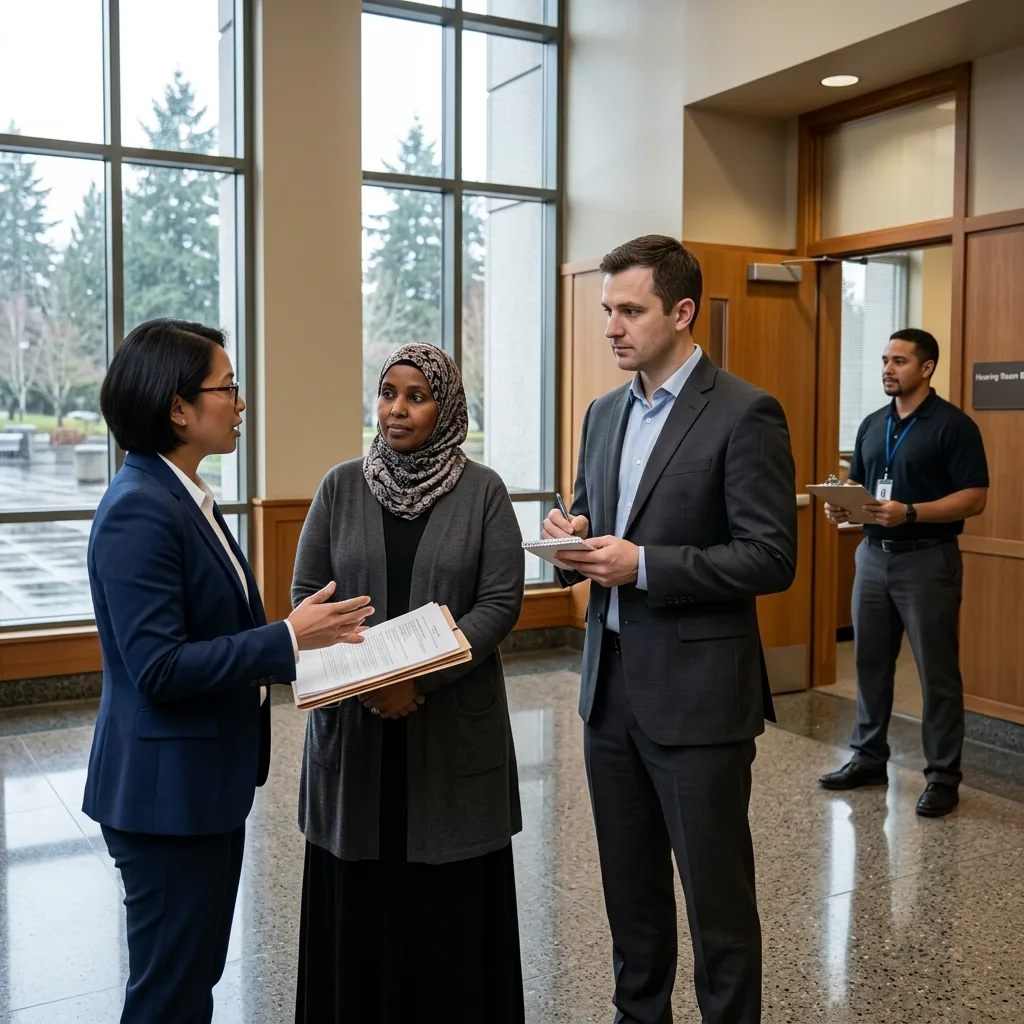
For years, one of the quieter due process failures in courtrooms across the country has been the language barrier. Non-English-speaking individuals sitting through proceedings they cannot understand, paying out of pocket for interpreter services they shouldn’t have to fund, or navigating credentialing gaps that leave them without qualified help at all. Washington State just moved to fix a significant piece of that problem.
What the Law Does
House Bill 1174, sponsored by Representative Strom Peterson (D-Edmonds), passed the Washington State Senate with a decisive 46-3 vote. The bill strengthens the court interpreter credentialing process, establishes clearer procedures for obtaining interpreter services, and critically limits when a person with limited English proficiency can be billed for those services. When costs arise in qualifying situations, the Washington Administrative Office of the Courts steps in to cover them.
The law takes effect 90 days after the legislative session concludes on April 27.
Why This Matters Beyond Washington
This isn’t just a regional administrative update. It’s a signal about how states are increasingly treating language access not as a logistical nicety, but as a constitutional baseline.
Peterson put it plainly: “The legal system isn’t just if some of the people interacting with it can’t understand what is happening.” That framing matters. It rejects the idea that interpreter access is a budget line item to be trimmed or a courtesy extended at a court’s discretion. It treats comprehension as a prerequisite to justice.
For attorneys working with LEP clients anywhere in the country, that framing has practical implications. Inadequate interpreter access has been the basis for appeals, ineffective assistance claims, and due process challenges. Washington’s move to codify credentialing standards and financial responsibility doesn’t just protect clients, it gives practitioners clearer ground to stand on when those standards aren’t met.
The Credentialing Gap Has Always Been the Real Problem
Availability of an interpreter and quality of interpretation are two entirely different problems, and the conversation around language access tends to collapse them into one.
Legal interpretation requires more than bilingual fluency. Accurately conveying the meaning of a criminal charge, the conditions of a plea agreement, or the testimony of a witness under cross-examination demands a specific and technical vocabulary in both languages, an understanding of how to handle terms that don’t translate directly, and enough familiarity with legal procedure to know when something is important enough to slow down and clarify. A court that technically provides an interpreter but has no enforceable credentialing standard can still produce proceedings where the LEP individual has little meaningful understanding of what is happening.
When those qualifications aren’t there, the failure is easy to miss in the moment and difficult to remedy afterward. A defendant who nodded through a plea colloquy because the interpreter didn’t flag that something was unclear, that’s the kind of problem that surfaces later, if it surfaces at all. HB 1174’s attention to credentialing is an acknowledgment that showing up isn’t the same as competent interpretation.
The Bottom Line
Washington’s HB 1174 is a meaningful step and a template worth watching. For attorneys who regularly work with clients who aren’t fluent in English, understanding the legal landscape around language access in your jurisdiction is part of competent representation. In many states, the rules around court interpretation are older, thinner, and less consistently enforced than they should be. Washington’s model, specific credentialing, defined process, cost protection, is a reasonable benchmark to measure your own jurisdiction against.

CEO & Founder
Born in Dallas, Texas, Alexandra grew up surrounded by Spanish, English, Arabic, and Italian. After moving to Venezuela, Spanish became her primary language. She holds a Master's in Healthcare Administration from Washington University in St. Louis and is a California court certified and medical interpreter.
She founded Kaplan Interpreting Services after seeing an industry that treated interpreters as interchangeable and clients as ticket numbers. She built a protocol-driven operation where every interpreter is hand-selected and credentialed for the specific setting, every client has a dedicated point of contact, and risk management is built into every assignment.
Her career reached a historic milestone when she interpreted the conversation between President-elect Biden and Pope Francis. That assignment, along with engagements for Nike and the Summit of the Americas, set the standard for every client engagement that followed.
"The same protocols that protected that historic conversation now protect every assignment we handle."